Chicken Piccata (Pounded Thin, Caper-Lemon Pan Sauce, Proper Technique)
Chicken piccata with a bright, briny lemon-caper pan sauce built from the chicken's dredging flour and rendered butter. The pounding and dredging create the crust. The fond creates the sauce.

“Chicken piccata takes 30 minutes and uses one pan. It also has three moments where it completely falls apart on most home cooks: the chicken isn't pounded thin enough so it cooks unevenly, the sauce is thin and watery rather than glossy and emulsified, or the lemon is overwhelming rather than bright. Each of those problems has a specific technical cause. Fix the cause and the dish is nearly foolproof.”
Why This Recipe Works
Chicken piccata is one of the cleanest expressions of the Italian-American pan sauce tradition — a thin cutlet, a simple dredge, a hot pan, and a sauce built entirely from the residue of cooking the chicken. It has four components: the prep (pounding), the crust (dredge and sear), the sauce (fond, deglaze, reduce, mount), and the finish (capers, lemon, parsley). Each one is straightforward. Each one has a specific mechanism that, when understood, makes the technique automatic.
Why Pounding Changes Everything
A chicken breast is not a uniform object. The lobe — the thick end — is roughly four times the mass of the thin tapered end. This creates a thermal gradient problem: in a 400°F pan, the thin end reaches 165°F internal temperature in 2-3 minutes while the thick lobe needs 5-6 minutes. By the time the thick end is cooked through, the thin end has been overcooked for several minutes, squeezing its moisture out and turning dry and stringy.
Pounding to a uniform 1/4 inch eliminates this gradient entirely. A uniformly thin cutlet has a consistent mass from edge to edge. Every part of it contacts the hot pan simultaneously and reaches the same internal temperature at the same time. The result is a chicken cutlet that is done from edge to edge in 3 minutes per side with no dry spots.
The mechanical process of pounding also serves a secondary purpose: it physically breaks the long muscle fibers, which run parallel to each other in an unworked breast. Broken fibers mean a more tender texture because you're not working against the structural integrity of intact protein strands when you chew. Pounded chicken piccata has a noticeably more tender bite than unpounded chicken breast cut to 1/4 inch on a slant.
The Dredge Is Not Just Coating — It's Sauce Infrastructure
The flour dredge serves the chicken and the sauce simultaneously, which is why it exists in this recipe even though you could technically skip it and sear the chicken plain.
On the chicken: the flour creates a thin, starchy crust that browns by Maillard reaction at the pan surface, forming a pleasantly golden exterior with light textural contrast to the soft cooked chicken beneath. The crust is thin enough to not be a barrier — you taste chicken, not breading.
In the pan: when the floured chicken sears, some flour transfers to the pan surface and browns with the chicken juices, becoming part of the fond. That starch, when dissolved by the deglazing liquid, provides a very slight natural thickening to the sauce. This is why piccata sauce has a barely-there viscosity that a straight-liquid sauce does not. It is not a thick sauce, but it coats a spoon rather than running off it. This thickening is subtle and happens automatically — the dredge does it for you.
Building a Pan Sauce: Four Steps, One Logic
The pan sauce for chicken piccata follows the same four-step logic as every French pan sauce: fond, deglaze, reduce, mount. Understanding this sequence means you can build a pan sauce from nearly any protein without a recipe.
Fond is the layer of browned, caramelized protein and sugar compounds stuck to the pan surface after the chicken has been removed. These compounds are the result of the Maillard reaction — hundreds of new flavor molecules created when amino acids and reducing sugars react above 280°F. The fond in a stainless steel cookware pan is darker, more concentrated, and more flavorful than what you'd get from nonstick. Do not discard it or panic about it — it is the foundation of the sauce.
Deglaze means adding liquid (here, white wine) to the hot pan while scraping vigorously. The alcohol in the wine dissolves fat-soluble fond compounds; the water fraction dissolves water-soluble ones. The deglazing liquid lifts all the fond off the pan and incorporates it into the sauce, transforming burned-looking residue into flavor-dense liquid.
Reduce means simmering the sauce until water evaporates, concentrating the dissolved flavor compounds and the collagen from the chicken broth into a denser, more intensely flavored liquid. A sauce that has reduced by half has twice the concentration of every flavor compound. This step also prepares the sauce for butter mounting — an under-reduced sauce is too watery to provide a stable base for emulsification.
Mount means adding cold butter off the boil, a tablespoon at a time, while swirling the pan. Cold butter is an emulsion of fat and water. Adding it to hot liquid disperses the fat droplets through the aqueous sauce in a stable emulsion — the same mechanism as mayonnaise, just in reverse proportions. The result is a glossy, cohesive sauce that clings to the chicken rather than separating into a puddle of clarified fat.
Why Capers Are Not Just Salty
Capers are the pickled flower buds of the Capparis spinosa plant, preserved in salt or vinegar brine. They contribute three distinct flavor dimensions to piccata: saltiness from the brine, acidity (sharp sourness distinct from the lemon), and a fermented umami depth that is the result of enzymatic breakdown during the curing process.
That fermented quality is what separates capers from simply adding more salt and more lemon. The fermentation produces compounds including phenolic acids and sulfur-containing volatile compounds that interact with the butter and chicken fat in the sauce to produce a savory, complex, briny note. This is why piccata tastes like more than lemon and chicken — the capers are doing invisible flavor architecture that doesn't taste like capers but tastes like depth.
Three tablespoons is the correct amount. Below two, the caper contribution gets lost. Above four, the brine starts to dominate the lemon.
Where Beginners Mess This Up
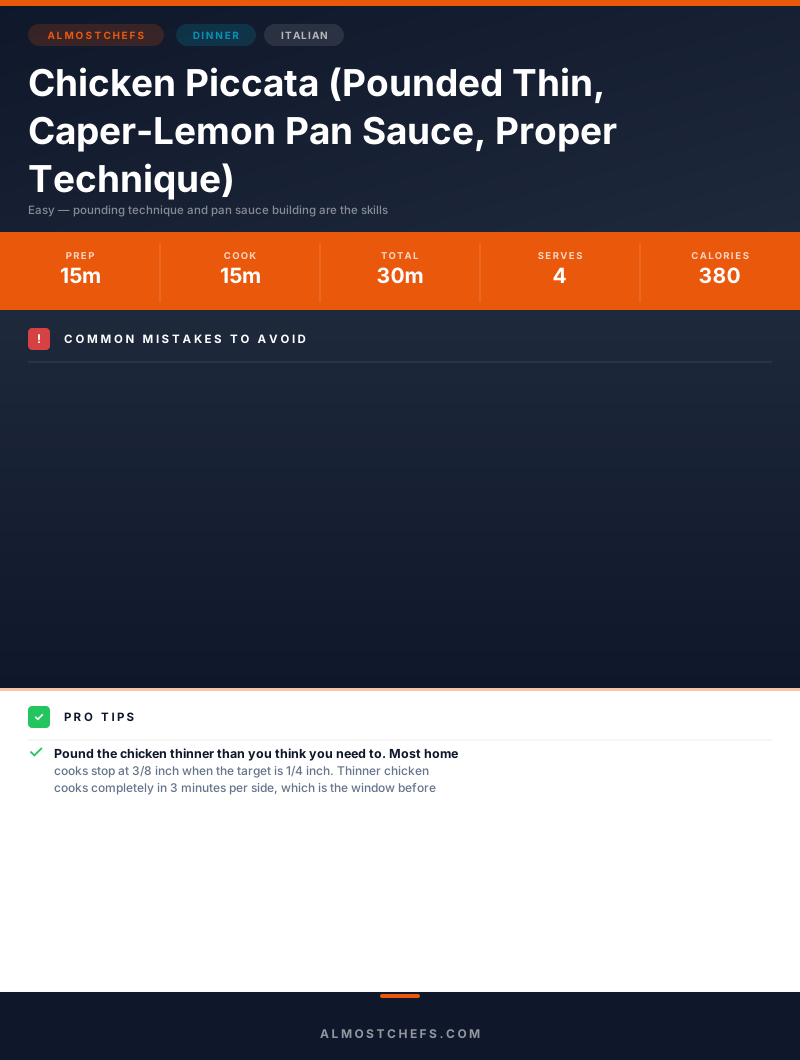
Before we start, read this. These are the 4 reasons your chicken piccata (pounded thin, caper-lemon pan sauce, proper technique) will fail:
- 1
Not pounding the chicken thin enough: Chicken breast varies dramatically in thickness from lobe to tip — sometimes from 1.5 inches at the thickest to under a quarter inch at the thinnest. This unevenness means that by the time the thickest part is cooked through, the thin end has been overcooked and dried out for several minutes. The target is a uniform 1/4 inch across the entire cutlet. That requires real force with a meat mallet — not a few gentle taps. Pound it flat.
- 2
Using bottled lemon juice: Fresh lemon juice contains citric acid and a large number of volatile aromatic compounds — aldehydes and terpenes — that are responsible for the bright, complex lemon flavor. Bottled lemon juice has been pasteurized, which destroys most of the volatile aromatics. What remains is sour but one-dimensional. In a sauce where lemon is the central flavor, this distinction is obvious. Use fresh lemon juice only.
- 3
Not letting the pan sauce reduce enough: A properly finished piccata sauce is glossy, slightly viscous, and coats the chicken rather than running off it. This requires the wine and broth to reduce by at least half before the butter goes in. Butter added to under-reduced liquid produces a thin, greasy sauce that breaks as it cools. Reduce first, then mount with butter. The reduction concentrates the flavor and provides a stable base for emulsification.
- 4
Adding butter to a sauce that's too hot: Mounting a pan sauce with butter (the French monter au beurre technique) requires that the sauce is hot but not boiling. At a rolling boil, butter breaks — the fat separates from the water fraction and the sauce becomes greasy and split. At a simmer or below, the cold butter emulsifies into the hot liquid, creating a glossy, unified sauce. Cold butter, hot (but not boiling) liquid. Add it a tablespoon at a time while swirling.
The Video Reference Library
Want to see it in action? Here are the exact videos we analyzed and combined to build this foolproof recipe translation:
The primary reference video. The pan sauce section is especially useful — watch how the deglazing releases the fond and how the butter is added in stages at the end. The distinction between a broken sauce and an emulsified sauce is visible here.
A technique-focused breakdown of the four-step pan sauce process. Piccata is one of the cleanest examples of this method. Understanding the mechanics here applies to dozens of other dishes.
Visual demonstration of how to pound chicken breast correctly, including how to judge when you've reached even thickness and how to handle the delicate thin edges without tearing.
🛠️ Core Equipment
- Meat mallet or heavy-bottomed panPounding chicken breast to 1/4 inch requires genuine force distributed evenly across the surface. A meat mallet with a flat face is ideal. The textured side breaks fibers and works for tenderizing but can tear the surface of the chicken. Use the flat side. In the absence of a mallet, use the bottom of a heavy skillet.
- Large stainless steel or carbon steel skillet (12-inch)Stainless steel and carbon steel develop fond — the browned bits that become the base of the pan sauce — better than nonstick or enameled surfaces. The fond in this recipe is the entire flavor foundation of the sauce. Nonstick prevents proper fond development. Use a stainless or carbon steel pan. See the [stainless steel cookware](/kitchen-gear/review/stainless-steel-cookware) review for specifics.
- Tongs or thin spatulaDredged, pounded chicken cutlets are delicate. Tongs allow you to flip and maneuver them without tearing the dredge coating. A thin flexible spatula works for flipping but offers less control when moving the cutlets out of the pan.
Chicken Piccata (Pounded Thin, Caper-Lemon Pan Sauce, Proper Technique)
🛒 Ingredients
- ✦4 boneless, skinless chicken breasts, pounded to 1/4 inch thickness
- ✦1/2 cup all-purpose flour
- ✦1 teaspoon kosher salt
- ✦1/2 teaspoon black pepper
- ✦4 tablespoons olive oil
- ✦4 tablespoons unsalted butter, divided, cold
- ✦4 cloves garlic, minced
- ✦1/2 cup dry white wine
- ✦1/2 cup low-sodium chicken broth
- ✦1/3 cup fresh lemon juice (about 2-3 large lemons)
- ✦3 tablespoons capers, drained
- ✦2 tablespoons fresh flat-leaf parsley, roughly chopped
- ✦Thin lemon slices for serving
👨🍳 Instructions
01Step 1
Place each chicken breast between two sheets of plastic wrap or in a zip-lock bag. Using a meat mallet (flat side) or the bottom of a heavy skillet, pound firmly from the center outward until the entire cutlet is a uniform 1/4 inch thick.
02Step 2
Combine the flour, 1 teaspoon salt, and 1/2 teaspoon black pepper in a shallow bowl. Dredge each pounded cutlet in the seasoned flour, pressing gently so the flour adheres. Shake off any excess.
03Step 3
Heat 4 tablespoons of olive oil in a large stainless steel or carbon steel skillet over medium-high heat until shimmering.
04Step 4
Working in batches if necessary, add the dredged chicken cutlets to the hot pan. Cook for 3 minutes without moving, until the underside is golden brown and the dredge is set. Flip and cook for another 2-3 minutes. Transfer to a plate and tent loosely with foil.
05Step 5
Reduce heat to medium. Add 1 tablespoon of butter to the pan. Add the minced garlic and cook for 30-60 seconds until fragrant, stirring constantly. Do not let it brown.
06Step 6
Pour in the white wine. Scrape the bottom of the pan with a wooden spoon to dissolve all the fond. Let the wine reduce for 2-3 minutes, scraping continuously at first to fully deglaze.
07Step 7
Add the chicken broth and lemon juice. Stir to combine. Bring to a simmer and cook for 3-4 minutes until the sauce has reduced by about half.
08Step 8
Reduce heat to low. Add the remaining 3 tablespoons of cold butter one tablespoon at a time, swirling the pan between each addition, until the sauce is glossy and slightly thickened.
09Step 9
Stir in the capers. Taste the sauce and adjust salt if needed.
10Step 10
Return the chicken cutlets to the pan, nestle them in the sauce, and spoon the sauce over them. Cook for 1 minute to reheat the chicken through.
11Step 11
Transfer to plates, spoon the sauce generously over each cutlet, and garnish with fresh parsley and lemon slices.
Nutrition Per Serving
Estimates based on standard preparation. Adjustments alter macros.
🔄 Substitutions
Instead of Dry white wine...
Use Chicken broth plus 1 tablespoon white wine vinegar
Eliminates the alcohol while preserving the acid and volume. The sauce will be slightly less complex — wine contains hundreds of flavor compounds that broth does not — but the result is still very good.
Instead of Capers...
Use Finely chopped green olives
Olives provide a similar salty, briny punch but lack the specific fermented flavor of capers. Use about 2 tablespoons of finely chopped castelvetrano or picholine olives. Avoid canned black olives — they're too mild and mushy.
Instead of Chicken breast...
Use Thinly sliced chicken thigh or turkey cutlets
Boneless thighs pound well and stay juicier than breast due to higher fat content. Turkey cutlets are an excellent substitute and take well to the same preparation. Both require the same pounding to 1/4 inch.
🧊 Storage & Reheating
In the Fridge
Store chicken and sauce together in an airtight container for up to 3 days. The dredge coating softens overnight as it absorbs the sauce — acceptable texture change. Reheat gently on the stovetop with a splash of chicken broth.
In the Freezer
Not recommended. The butter-mounted sauce breaks when frozen and thawed, and the chicken coating becomes waterlogged. This dish is best made fresh.
Reheating Rules
Reheat in a skillet over medium-low with 2-3 tablespoons of chicken broth, spooning the sauce over the chicken as it warms. Do not microwave — it toughens the chicken and breaks the sauce.
❓ Frequently Asked Questions
Why is my pan sauce greasy and separated?
The butter broke during mounting — either the sauce was at a full boil when the butter went in, or you added the butter too quickly without giving each tablespoon time to emulsify. To rescue a broken sauce: remove from heat, let it cool for 30 seconds, add 1 tablespoon of cold water, and whisk or swirl vigorously. The sauce will often re-emulsify. Going forward, add butter off the boil, one tablespoon at a time.
Can I make chicken piccata without wine?
Yes. Replace the wine with an equal volume of chicken broth and add a tablespoon of white wine vinegar to approximate the acidity. The sauce will be slightly simpler in flavor but still excellent. The acid in the vinegar helps dissolve the fond during deglazing just as the wine does.
Why does my lemon sauce taste harsh and bitter?
Two possible causes: too much lemon juice (1/3 cup is the maximum — beyond that, the bitterness of the lemon pith compounds become dominant), or the lemon juice was added and not reduced enough to mellow the sharp acidity. Let the sauce reduce for a full 3-4 minutes after the lemon juice goes in. The volatile sour compounds partially evaporate with reduction, leaving a brighter, less harsh lemon flavor.
Can I use chicken thighs instead of breast?
Yes. Pound boneless thighs to 1/4 inch (they can be a bit uneven since they have more connective tissue — work slowly). Thighs have more fat and will stay juicier through cooking. The flavor is richer and slightly less delicate than breast, which works well with the bright, briny sauce.
What do I serve with chicken piccata?
The sauce is the point — you want something to carry it. Angel hair pasta or thin spaghetti dressed with the extra sauce is the classic pairing. Mashed potatoes work well. A simple green vegetable — roasted asparagus, sautéed spinach, steamed broccolini — balances the richness. Crusty bread is non-optional if there is sauce left in the pan.
The Science of
Chicken Piccata (Pounded Thin, Caper-Lemon Pan Sauce, Proper Technique)
We turned everything on this page into a beautiful, flour-proof PDF cheat sheet. Print it out, stick it to your fridge, and never mess up your chicken piccata (pounded thin, caper-lemon pan sauce, proper technique) again.
*We'll email you the high-res PDF instantly. No spam, just perfectly cooked meals.
AlmostChefs Editorial Team
We translate the internet's most popular cooking videos into foolproof, beginner-friendly written recipes. We analyze multiple methods, test them in our kitchen, and engineer a single "Master Recipe" that gives you the best possible result with the least possible stress.