Crispy Chicken Kiev (The Butter-Burst Method That Actually Works)
A classic Eastern European showstopper — pounded chicken breasts stuffed with garlic herb butter, breaded, seared golden, and oven-finished. We stripped the deep-fryer, kept the drama, and built a foolproof weeknight method that still delivers that iconic butter flood when you cut in.

“Chicken Kiev has a reputation problem. Every cooking show treats it like a project — deep fryer mandatory, three hours minimum, fail state guaranteed. None of that is true. The dish is a pounded chicken breast wrapped around herb butter and fried crispy. The deep fryer was always optional. What's not optional is sealing the butter inside properly, hitting the right internal temp, and resting the chicken before you cut it. Get those three right and you get the puddle. Skip any one and you get a dry roll with a sad empty cavity.”
Why This Recipe Works
Chicken Kiev is the only dish in European cooking with a hidden liquid center engineered entirely by physics. There's no sauce added at the table. No gravy poured from a boat. The butter floods the plate because a sealed pocket of fat reaches the right temperature inside a finished piece of chicken and has nowhere to go when you cut it. That's the whole trick. Everything else in the recipe exists to make that moment possible.
The Seal Is the Dish
Most home cooks fail at Chicken Kiev at step four: rolling the breast. A loose roll means a failed seal. A failed seal means the butter liquefies in the pan at 250°F, leaks through the seam, and spatters into the oil before the chicken has been in the skillet for two minutes. You end up with a dry, butterless roll and a very fragrant kitchen.
The breast needs to be pounded to a genuine quarter-inch before rolling — not "pretty thin," not "thin enough." Quarter inch. This creates enough surface area to wrap the butter with significant overlap, and the overlapping layers of meat fuse slightly under pan heat to form a self-sealing join. Pound unevenly and one side of the roll will be thicker than the other, which means one side cooks faster and the pressure differential pushes the butter toward the weak seam. Then the seam fails. The goal is a cylinder so uniform it looks machined.
Sear First, Oven Second
The two-stage cooking method solves a problem that deep frying handles through sheer violence: getting a crispy crust on the outside while cooking chicken safely on the inside without burning one or undercooking the other. A deep fryer maintains oil at 350°F and surrounds the entire roll simultaneously — fast, even, aggressive. A home kitchen can't replicate that without a proper Dutch oven full of oil and a thermometer managing it constantly.
The sear-and-bake method is not a compromise. It's actually more controllable. The sear at medium-high builds the Maillard crust on the panko surface in 3-4 minutes per side — the same browning reaction that makes roasted bread taste different from steamed bread. The oven then takes over, surrounding the roll with even, dry heat that penetrates through the crust into the chicken at a pace that leaves the coating intact and brings the interior to 165°F without any risk of burning. Adding broth to the pan during the oven phase keeps the environment slightly humid, which prevents the bottom of the roll from over-drying against the hot pan surface.
The Herb Butter Composition
The butter filling isn't decorative. It serves as the cooking medium for the inside of the chicken during the oven phase — the chicken is essentially poaching in herb butter from the inside while the outside crisps. This is why the quality of the butter matters and why skimping on the garlic is noticeable in every bite.
Fresh herbs are non-negotiable here. Dried parsley in herb butter tastes like green sawdust. Fresh parsley, dill, and thyme release their volatile aromatic compounds into the surrounding fat during cooking, and that fat permeates the chicken from within. The garlic must be minced extremely fine — not pressed, not rough-chopped — because coarse garlic pieces create air pockets in the butter that can compromise the roll's structural integrity and cook unevenly.
The Rest
Three minutes of rest after the oven is not a suggestion. The butter inside the chicken is fully liquefied at 165°F. Cut it immediately and it sprays outward under pressure. Let it rest and the butter cools slightly, loses some pressure, and flows rather than erupts when the knife goes in. This is the difference between a flooded plate and a stained shirt. Rest the chicken. Then cut at an angle across the center. Then listen for the moment Chicken Kiev justifies its reputation.
Where Beginners Mess This Up
Before we start, read this. These are the 4 reasons your crispy chicken kiev (the butter-burst method that actually works) will fail:
- 1
Sealing the butter poorly: If the chicken isn't rolled tightly enough or the edges aren't pressed closed, the herb butter liquefies in the pan and escapes before it ever reaches the plate. The chicken needs to be a compact, sealed cylinder — not a loose wrap. Pound thin enough that the breast can fold completely around the filling with significant overlap.
- 2
Pounding unevenly: Thick spots at the edges or center mean the breast won't roll into a uniform cylinder. You'll get a bulging seam that blows out under pan heat. Work from the center outward in slow, even strokes until you have a consistent quarter-inch thickness across the entire piece.
- 3
Skipping the oven finish: Pan searing alone produces a golden exterior and raw center. The sear is for crust development only — 3-4 minutes per side. The oven takes the internal temperature to 165°F without burning the panko. Skipping the oven step is why home cooks end up with raw chicken and overcooked coating.
- 4
Cutting immediately after cooking: The herb butter needs 3-4 minutes to partially re-solidify after the oven. Cut too early and it sprays rather than pools — you lose the presentation and half the flavor. Rest the chicken on the plate before you touch it.
The Video Reference Library
Want to see it in action? Here are the exact videos we analyzed and combined to build this foolproof recipe translation:
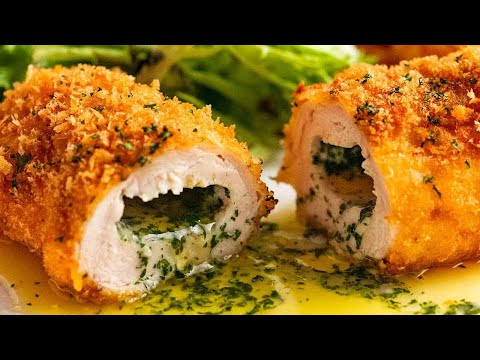
The source video for this recipe. Clear demonstrations of the pounding technique, butter placement, rolling, and searing method. Watch particularly for how the roll is handled during the breading process to avoid losing the seal.
2. Classic Chicken Kiev Technique
Covers the traditional deep-fried version alongside the oven-finish method, useful context for understanding why the butter behaves differently depending on cooking approach.
3. Weeknight Chicken Kiev SimplifiedFocused on speed and consistency — good reference for the breading station setup and how to handle the rolls gently after searing without cracking the panko crust.
🛠️ Core Equipment
- Meat mallet ↗Consistent quarter-inch thickness is impossible to achieve with a rolling pin or fist. The mallet distributes force evenly and prevents tears. If your chicken breasts are thick, a few targeted strikes in the center before working outward saves significant time.
- Oven-safe skillet ↗You need to go from stovetop sear to oven finish in one pan. Cast iron or stainless steel handles this transition cleanly. Non-stick pans generally can't handle the high sear temperatures needed for proper crust development.
- Instant-read thermometer ↗165°F at the thickest part is the only reliable way to confirm doneness. The rolls look identical whether they're at 155°F or 175°F — the thermometer is the only way to thread the needle between raw and overcooked.
- Plastic wrap ↗Two sheets of plastic wrap surrounding the chicken breast protect against tears during pounding and keep meat fibers from shredding. Pounding directly on a bare board or against bare meat produces ragged edges that won't seal.
Crispy Chicken Kiev (The Butter-Burst Method That Actually Works)
🛒 Ingredients
- ✦4 boneless, skinless chicken breasts, about 6 ounces each
- ✦6 tablespoons unsalted butter, softened
- ✦4 cloves garlic, minced very fine
- ✦3 tablespoons fresh parsley, finely chopped
- ✦1 tablespoon fresh dill, finely chopped
- ✦1 teaspoon fresh thyme leaves
- ✦1 teaspoon kosher salt, divided
- ✦1/2 teaspoon freshly ground black pepper, divided
- ✦1 cup all-purpose flour
- ✦2 large eggs
- ✦2 tablespoons water or whole milk
- ✦1 1/2 cups panko breadcrumbs
- ✦3 tablespoons olive oil
- ✦2 tablespoons unsalted butter for cooking
- ✦1/2 cup low-sodium chicken broth
- ✦2 lemon wedges for garnish
- ✦Fresh parsley sprigs for serving
👨🍳 Instructions
01Step 1
Combine softened butter with minced garlic, parsley, dill, and thyme in a small bowl. Stir until fully blended. Season with a pinch of salt and pepper.
02Step 2
Place each chicken breast between two sheets of plastic wrap. Using a meat mallet, pound from the center outward until each breast is uniformly 1/4 inch thick. Work slowly to avoid tears at the edges.
03Step 3
Lay each flattened breast flat. Place about 1 1/2 tablespoons of herb butter in the center of each piece.
04Step 4
Fold the sides of each breast inward over the butter, then roll tightly from the narrow end to form a compact cylinder. Press the seam and ends firmly to seal completely.
05Step 5
Set up three shallow bowls: flour mixed with 1/2 teaspoon salt and 1/4 teaspoon pepper in the first; eggs whisked with water or milk in the second; panko breadcrumbs in the third.
06Step 6
Dredge each roll in flour, shaking off excess. Dip fully in the egg wash. Press firmly into panko on all sides. Make sure the entire surface is coated.
07Step 7
Preheat your oven to 375°F.
08Step 8
Heat olive oil and butter together in a large oven-safe skillet over medium-high heat until the butter foams and the oil shimmers, about 2 minutes.
09Step 9
Place the breaded rolls in the skillet without crowding. Sear for 3-4 minutes per side until the coating is deep golden brown.
10Step 10
Pour chicken broth around (not over) the rolls in the skillet.
11Step 11
Transfer the skillet to the oven and bake for 12-15 minutes until the internal temperature reads 165°F at the thickest point.
12Step 12
Remove from oven. Rest, untouched, for 3-4 minutes before plating.
13Step 13
Plate the rolls, drizzle with pan juices, and garnish with fresh parsley sprigs and lemon wedges.
Nutrition Per Serving
Estimates based on standard preparation. Adjustments alter macros.
🔄 Substitutions
Instead of All-purpose flour...
Use Whole wheat flour or a 50/50 oat flour blend
Slightly nuttier flavor and denser coating. Minimal texture difference in the final crust. Increases fiber and lowers glycemic impact.
Instead of Panko breadcrumbs...
Use Crushed almonds mixed with panko (1:1 ratio)
Richer, more savory crust with a crunchier texture. Boosts protein and healthy fats. Works best if the almonds are very finely crushed so they adhere to the egg wash.
Instead of Unsalted butter in filling...
Use 3 tablespoons unsalted butter + 3 tablespoons Greek yogurt, mixed together
Slightly lighter filling with a mild tangy undertone. Still melts well when heated. Reduces saturated fat without losing the creamy texture that makes Kiev worth making.
Instead of Chicken broth...
Use Unsweetened bone broth
Deeper, more nourishing flavor. The gelatin in bone broth also produces slightly richer pan juices for drizzling.
🧊 Storage & Reheating
In the Fridge
Store cooked rolls in an airtight container for up to 3 days. The crust softens in the fridge — that's unavoidable.
In the Freezer
Freeze uncooked, fully assembled and breaded rolls on a sheet tray until solid, then transfer to a freezer bag. Cook from frozen at 375°F for 25-30 minutes without searing first, or thaw overnight and proceed with the normal method.
Reheating Rules
Reheat in a 350°F oven for 10-12 minutes. Avoid the microwave — it softens the crust completely and can cause the butter to boil out through the coating.
❓ Frequently Asked Questions
Why did all my butter leak out during cooking?
The seal failed. Either the breast wasn't pounded thin enough to create enough overlap when rolled, the roll was too loose, or the seam was placed face-up in the pan where direct heat melted it open. Seal tightly, seam-side down first in the skillet, and make sure the roll is genuinely compact before breading.
Can I make these ahead of time?
Yes — this is one of the best make-ahead dinner options available. Assemble, bread, and refrigerate the rolls up to 24 hours before cooking. The chill actually firms up the butter filling and makes the rolls easier to handle in the pan. Don't sear them cold from the fridge; let them sit at room temperature for 15 minutes first.
Do I have to shallow fry? Can I just bake them?
You can bake them entirely at 400°F for 22-25 minutes on a wire rack set over a sheet pan, sprayed with oil. The crust won't be quite as deeply golden or crispy, but the butter seal holds just as well and the chicken finishes evenly. It's a reasonable tradeoff if you want to skip the stovetop step.
What internal temperature should chicken kiev reach?
165°F at the thickest part of the roll, measured with an instant-read thermometer. Insert the probe from the end of the roll toward the center. This is the only reliable doneness check — the exterior color tells you nothing about the interior temperature.
My panko crust burned before the chicken was cooked through. What happened?
The pan heat was too high during the sear, or the oven temperature was running hot. The sear should be at medium-high, not high — you want color development over 3-4 minutes, not instant charring. Use an oven thermometer to verify your oven is actually at 375°F. If the crust is darkening too fast in the oven, tent loosely with foil.
Can I use frozen chicken breasts?
Thaw completely before pounding. Partially frozen chicken tears badly under the mallet and won't pound to an even thickness. Pat dry thoroughly after thawing — excess surface moisture prevents the flour from adhering and the egg wash from coating properly.
The Science of
Crispy Chicken Kiev (The Butter-Burst Method That Actually Works)
We turned everything on this page into a beautiful, flour-proof PDF cheat sheet. Print it out, stick it to your fridge, and never mess up your crispy chicken kiev (the butter-burst method that actually works) again.
*We'll email you the high-res PDF instantly. No spam, just perfectly cooked meals.
AlmostChefs Editorial Team
We translate the internet's most popular cooking videos into foolproof, beginner-friendly written recipes. We analyze multiple methods, test them in our kitchen, and engineer a single "Master Recipe" that gives you the best possible result with the least possible stress.