Chicken Cordon Bleu (Properly Rolled, Panko Crust, Dijon Cream Sauce)
Chicken cordon bleu done correctly — pounded thin, tightly rolled with ham and Swiss, breaded in panko, and baked until golden. The rolling technique and toothpick securing are what prevent it from falling apart.

“Most chicken cordon bleu fails at the roll. The cheese leaks out, the ham bunches up, the whole thing unravels in the pan and you end up with a flat, sauce-covered mess. That failure is entirely preventable — it's a geometry and temperature problem, not a cooking problem. Pound it thin, roll it tight, secure it properly, and the rest is just execution.”
Why This Recipe Works
Chicken cordon bleu is a French technique applied to a humble ingredient, and like most French technique, it rewards precision and punishes shortcuts. The dish isn't complicated — it's a pounded chicken breast wrapped around ham and cheese, breaded, and cooked until the exterior is golden and the interior is melted. But every element in that sentence is load-bearing, and cutting corners on any one of them produces the version you've probably eaten: a thick, unevenly cooked breast where the ham has wandered to one end, the cheese has escaped through a seam crack, and the breading is half-soft from butter pooling under the roll.
The fix isn't magic. It's mechanics.
Why Pounding Thin Is Not a Suggestion
A raw chicken breast is shaped like a teardrop — 1.5 inches thick at the lobe and tapered to half that at the point. This geometry is incompatible with rolling. A thick breast resists the roll, creating tension that the filling pushes against from the inside. The seam cracks. The filling leaks. The roll expands unevenly in the pan and you get a lopsided oval that browns on one side and steams on the other.
Pound it to 1/4 inch uniformly and everything changes. A thin sheet of chicken folds without resistance. The roll can be made genuinely tight — you can feel it as you work. The filling is compressed rather than sitting loosely in a pocket, which means it stays centered as the protein tightens during cooking rather than migrating toward whatever gap presents itself.
The physics are simple: a thinner piece has less structural resistance to deformation. You're using that to your advantage. The meat mallet is not a tool you can substitute with approximation — it's the instrument that creates the raw material everything else depends on.
Even cooking is the second benefit. A rolled breast cooked from 1/4-inch sheet reaches its target temperature throughout within a predictable window. A thick breast takes so long to cook through that the exterior passes through every shade of done before the center is safe to eat. Uniform thickness eliminates that variable.
The Roll and Why Every Millimeter Matters
The rolling technique is the single most consequential step in the recipe and the one most people execute badly because they learned it by intuition rather than instruction. Here's the actual mechanics:
Lay your ham slices leaving a half-inch border on all sides. This border is the structural margin — the ham that sits at the edge will be compressed and sealed as the chicken rolls over it. Filling that extends to the very edge will squeeze out the moment tension is applied. Cheese, unlike ham, flows when it heats — it needs containment, and the border provides it.
Start the roll at the short end, tucking tightly from the first turn. Each subsequent revolution should feel like you're compressing the roll, not just folding it. A loose roll has air pockets; a tight roll is solid. The difference is tactile. Press in from the sides as you roll to prevent the filling from migrating lengthwise — this is the burrito principle applied to protein.
Toothpicks are not optional and are not a sign that your roll failed. They are a mechanical locking system that prevents thermal expansion from undoing the roll during cooking. Chicken tightens and contracts as it heats. That contraction, without toothpicks, becomes force pushing the seam open. Three toothpicks per roll — both ends and the midpoint — distribute that force without any single point failing.
How the Panko Crust Actually Works
The breading sequence on a rolled bundle is harder than on a flat cutlet because you're coating a curved surface. Panko is the right choice here not just for texture but for structure — the angular, irregular flakes of panko lock together when compressed, forming a coherent shell rather than a loose coating. Fine breadcrumbs on a roll tend to slide off at the curves; panko stays.
The three-stage sequence — flour, egg, panko — serves chemistry, not tradition. Chicken's surface is too moist and too smooth for dry coating to adhere directly. Flour solves the moisture problem by absorbing surface water and creating a dry, lightly tacky base. Egg solves the adhesion problem: its proteins form a hydrophilic bond with the flour below and the panko above when heat is applied, essentially fusing the layers. Panko is then pressed — not just applied — into the egg surface, maximizing contact area.
Pressing is the non-negotiable variable most home cooks skip. After rolling through the panko, press the entire surface of the roll firmly against your palm, rotating to cover all angles. This compresses the panko into the egg coating, removing air gaps and creating a mechanically bonded shell rather than a loosely adhered layer. Panko that isn't pressed will scatter the moment it contacts hot butter.
The paprika and garlic powder in the panko are not flavor afterthoughts — paprika contains carotenoid pigments that accelerate Maillard browning at lower temperatures, giving you color before the chicken is at risk of overcooking. It's functional as much as it is flavorful.
Pan-Sear First, Oven Second — The Two-Stage Cook
A rolled chicken bundle is too thick to cook through with stovetop heat alone without burning the exterior. The center of a tight roll is 1.5 to 2 inches from the outer surface — heat conducted through breading and protein takes significant time to reach it at stovetop temperatures. If you try to cook cordon bleu through entirely on the stovetop, you'll char the crust before the core reaches safe temperature.
The two-stage method solves this. The sear — 4 to 5 minutes at medium heat total, rotating to hit all four sides — is purely about crust development. Direct contact with butter in a hot pan drives the Maillard reaction: proteins and sugars at the surface break down and recombine into hundreds of new aromatic compounds that are the actual flavor of browned food. You cannot replicate this with oven air alone.
The oven then provides 18 to 22 minutes of gentle, even ambient heat that penetrates the roll from all directions simultaneously, bringing the core to 160°F without burning the exterior that the sear already developed. The cast iron skillet is ideal for this because it moves directly from stovetop to oven without heat loss between vessels, and its thermal mass keeps the base of the rolls in contact with consistent heat throughout the bake.
The Dijon Cream Sauce as Flavor Architecture
The sauce isn't garnish. It's the flavor bridge between the neutral, crispy exterior of the roll and the rich, salty ham-and-cheese interior. Without it, the dish lands as two flavor zones with no connection. The sauce provides the third element — acid from the Dijon, richness from the cream, savory depth from the chicken broth — that makes the entire plate coherent.
The roux base (butter plus flour, cooked 60 seconds) is the structural component of the sauce. A 1:1 ratio of fat to flour creates a medium roux that, when combined with broth and cream at roughly a 4:1 liquid-to-roux ratio, produces a sauce with enough body to coat the back of a spoon without being gluey. Cook the roux for the full 60 seconds — raw flour carries a starchy, pasty flavor that persists through the sauce if not cooked out.
Dijon goes in off heat. This is a firm rule with a clear reason: mustard's characteristic sharpness comes from volatile sulfur compounds, specifically allyl isothiocyanate, that break down rapidly under sustained high heat. Add Dijon to a boiling sauce and those compounds cook off before they hit the palate. Add it off heat and they survive into the finished dish, delivering the sharp, mustard-forward character that makes the sauce identifiable. The difference is not subtle.
The result — a properly rolled, panko-crusted, oven-finished chicken cordon bleu with a Dijon cream sauce — is a dish that earns the word elegant. Not because it's complicated. Because every step in it has a reason.
Where Beginners Mess This Up
Before we start, read this. These are the 4 reasons your chicken cordon bleu (properly rolled, panko crust, dijon cream sauce) will fail:
- 1
Uneven thickness before rolling: A chicken breast that's thick in the center and thin at the edges won't roll evenly. The thick part resists the roll and creates voids where the filling shifts. Pound to a uniform 1/4-inch thickness before you touch a single slice of ham. This is not optional — it's the entire structural foundation of the roll.
- 2
Overfilling the center: Two slices of ham and two slices of cheese per breast is the maximum. More filling means more bulk at the center, which prevents a tight roll and leaves you with a seam that will crack open during searing. Resist the temptation to add more. The filling expands as the cheese melts.
- 3
Skipping the toothpick step: The seam on a rolled chicken breast will open the moment it hits hot butter. Secure it with 2–3 toothpicks before breading — one at each end and one at the midpoint. Remove them before serving. This single step is the difference between a tight, intact roll and an explosion of melted cheese on your pan.
- 4
Searing at too high a heat: Cordon bleu is thicker than a flat cutlet. High heat browns the outside fast while leaving the core raw. Medium heat is correct — 4–5 minutes per side in the pan, then finish in the oven. The oven's ambient heat reaches the interior without burning the crust.
The Video Reference Library
Want to see it in action? Here are the exact videos we analyzed and combined to build this foolproof recipe translation:
The foundational reference for this recipe. Weissman demonstrates the pounding technique, rolling sequence, and the Dijon cream sauce build in real time. Watch the rolling section twice before attempting it.
🛠️ Core Equipment
- Meat malletYou cannot pound a chicken breast to uniform 1/4-inch thickness with a rolling pin or the heel of your hand. A flat-faced [meat mallet](/kitchen-gear/review/meat-mallet) gives you controlled, even compression without tearing the muscle fibers.
- Oven-safe skillet (cast iron preferred)You need to sear on the stovetop and finish in the oven in the same vessel. A [cast iron skillet](/kitchen-gear/review/cast-iron-skillet) holds even heat across the entire surface, which means consistent browning on all four sides of a round roll — not just the flat face.
- Instant-read thermometerRolled chicken is harder to judge visually than a flat cutlet because the exterior looks done well before the center is safe to eat. Pull it at 160°F internal — carryover cooking brings it to 165°F while it rests. An [instant-read thermometer](/kitchen-gear/review/instant-read-thermometer) is the only way to know.
- Three shallow bowlsThe flour-egg-panko breading sequence requires dedicated, wide vessels. Deep bowls create uneven coverage on a cylindrical rolled piece. Wide, flat bowls let you roll the bundle through each medium without awkward repositioning.
- ToothpicksThe mechanical locking mechanism of the roll. Nothing else does this job reliably. Use 3 per roll, placed at both ends and the middle seam, to prevent the filling from shifting during breading and searing.
Chicken Cordon Bleu (Properly Rolled, Panko Crust, Dijon Cream Sauce)
🛒 Ingredients
- ✦4 boneless, skinless chicken breasts (6–8 oz each)
- ✦8 slices Black Forest ham
- ✦8 slices Swiss cheese
- ✦1 cup all-purpose flour
- ✦2 large eggs, beaten
- ✦1 cup panko breadcrumbs
- ✦1 teaspoon garlic powder
- ✦1 teaspoon paprika
- ✦1 teaspoon kosher salt
- ✦1/2 teaspoon freshly ground black pepper
- ✦Toothpicks (10–12)
- ✦2 tablespoons butter (for searing)
- ✦2 tablespoons butter (for sauce)
- ✦2 tablespoons all-purpose flour (for sauce)
- ✦1 cup chicken broth
- ✦1/2 cup heavy cream
- ✦2 tablespoons Dijon mustard
- ✦Salt and pepper to taste
👨🍳 Instructions
01Step 1
Preheat oven to 375°F. Line a baking sheet with a wire rack if you plan to finish the rolls on the rack rather than in the skillet.
02Step 2
Place each chicken breast between two sheets of plastic wrap. Using a meat mallet, pound to a uniform 1/4-inch thickness, working from the center outward with firm, controlled strokes.
03Step 3
Season each pounded breast with salt and pepper on both sides.
04Step 4
Lay 2 slices of ham on each breast, leaving a 1/2-inch border around all edges. Layer 2 slices of Swiss cheese on top of the ham.
05Step 5
Starting from the short end, roll each breast tightly into a cylinder. Tuck in the sides as you roll, like a burrito. Secure the seam and both ends with toothpicks — 3 per roll minimum.
06Step 6
Set up three shallow bowls: flour mixed with garlic powder, paprika, salt and pepper in the first; beaten eggs in the second; panko in the third.
07Step 7
Roll each secured bundle through flour, shaking off excess. Dip in egg wash to fully coat. Roll through panko, pressing firmly on all sides so the crumbs adhere.
08Step 8
Heat 2 tablespoons butter in a large oven-safe skillet over medium heat until foaming subsides. Sear the rolls on all sides, about 4–5 minutes total, turning every 60–90 seconds to brown evenly.
09Step 9
Transfer the skillet to the oven (or move rolls to a rack-lined baking sheet). Bake for 18–22 minutes until an instant-read thermometer inserted into the thickest part reads 160°F.
10Step 10
While the rolls bake, make the sauce. In a small saucepan, melt 2 tablespoons butter over medium heat. Whisk in 2 tablespoons flour and cook 60 seconds, stirring constantly, until the roux turns pale gold.
11Step 11
Whisk in chicken broth in a slow stream, then add heavy cream. Bring to a gentle simmer, whisking until the sauce thickens, 3–4 minutes. Remove from heat and whisk in Dijon mustard. Season with salt and pepper.
12Step 12
Rest the rolls for 5 minutes after pulling from the oven. Remove all toothpicks before slicing. Slice each roll on a diagonal to reveal the cross-section of ham and melted cheese. Serve with Dijon cream sauce.
Nutrition Per Serving
Estimates based on standard preparation. Adjustments alter macros.
🔄 Substitutions
Instead of Black Forest ham...
Use Prosciutto di Parma
Thinner, saltier, and more intensely flavored than Black Forest ham. Use 3–4 slices per breast to account for the thinner cut. The saltiness of prosciutto means you should season the chicken itself more lightly.
Instead of Swiss cheese...
Use Gruyère
The classical French choice for this dish — more complex, sharper, and nuttier than generic Swiss. It melts smoothly and stays put inside the roll rather than breaking into greasy pools. Worth the modest price premium.
Instead of Panko breadcrumbs...
Use Regular seasoned breadcrumbs
Finer texture produces a denser crust without panko's characteristic shatter. The roll will look cleaner but won't have the same audible crunch. Works fine if panko isn't available — adjust searing time slightly downward as fine crumbs brown faster.
Instead of Heavy cream...
Use Half-and-half
Reduces the fat content of the sauce but also its body. The sauce will be thinner with half-and-half. Compensate by simmering an extra 2–3 minutes to reduce slightly before adding the Dijon.
🧊 Storage & Reheating
In the Fridge
Store assembled, cooked rolls whole (not sliced) in an airtight container for up to 3 days. Slicing before storage accelerates moisture loss and makes the cut faces of the roll dry out.
In the Freezer
Freeze before baking — after the sear, before the oven. Wrap each roll individually in plastic wrap, then foil. Freeze up to 2 months. Thaw overnight in the refrigerator and bake at 375°F for 22–25 minutes.
Reheating Rules
Reheat in a 350°F oven for 12–15 minutes, uncovered, until warmed through. The oven preserves more crust texture than a microwave, which will soften the panko into a limp shell within 90 seconds.
❓ Frequently Asked Questions
Why does my cheese leak out during cooking?
Three causes: the roll wasn't tight enough, the filling extended too close to the edge, or the toothpicks weren't adequately securing the seam. Review all three. Chilling the rolls for 20 minutes before searing also helps — the cold firms up the filling and slows the melt.
Can I bake these without searing first?
Technically yes, but the crust will be pale and soft rather than golden and crisp. The Maillard reaction that produces crust color and flavor requires direct contact with a hot, fat-coated surface — not oven air. Bake-only cordon bleu is edible. It's just not as good.
How do I know when they're cooked through without cutting into them?
Use an instant-read thermometer inserted at an angle into the thickest end of the roll. You're looking for 160°F — carryover heat during the 5-minute rest brings it to 165°F. Cutting to check releases moisture and deflates the roll.
Can I use chicken thighs instead of breasts?
Boneless, skinless thighs work but are harder to pound into a clean uniform sheet because the muscle groups run in different directions. They're more forgiving of overcooking due to higher fat content, but rolling them into a neat cylinder is more technically demanding. Breasts are the right tool for this job.
What's the right Dijon mustard for the sauce?
Standard smooth Dijon — not whole grain, not honey mustard. Whole grain adds texture to the sauce in a way that doesn't work. Honey mustard adds sugar that throws off the balance. Plain Dijon gives you sharpness and acidity without either problem.
Can I make these ahead for a dinner party?
Yes. Pound, fill, roll, secure, and bread up to 24 hours ahead. Refrigerate on a wire rack uncovered — the open air keeps the panko from going damp. Sear and bake as directed just before serving. Make the sauce ahead and reheat gently while the rolls finish in the oven.
My panko coating is falling off — what went wrong?
Either the chicken was damp when it hit the flour, or you didn't press the panko firmly enough into the surface. Dry the exterior of each secured roll with paper towels before dredging. After the panko stage, press each side firmly against your palm. Let the breaded rolls rest 5 minutes before they hit the butter — the coating needs time to hydrate and bind.
The Science of
Chicken Cordon Bleu (Properly Rolled, Panko Crust, Dijon Cream Sauce)
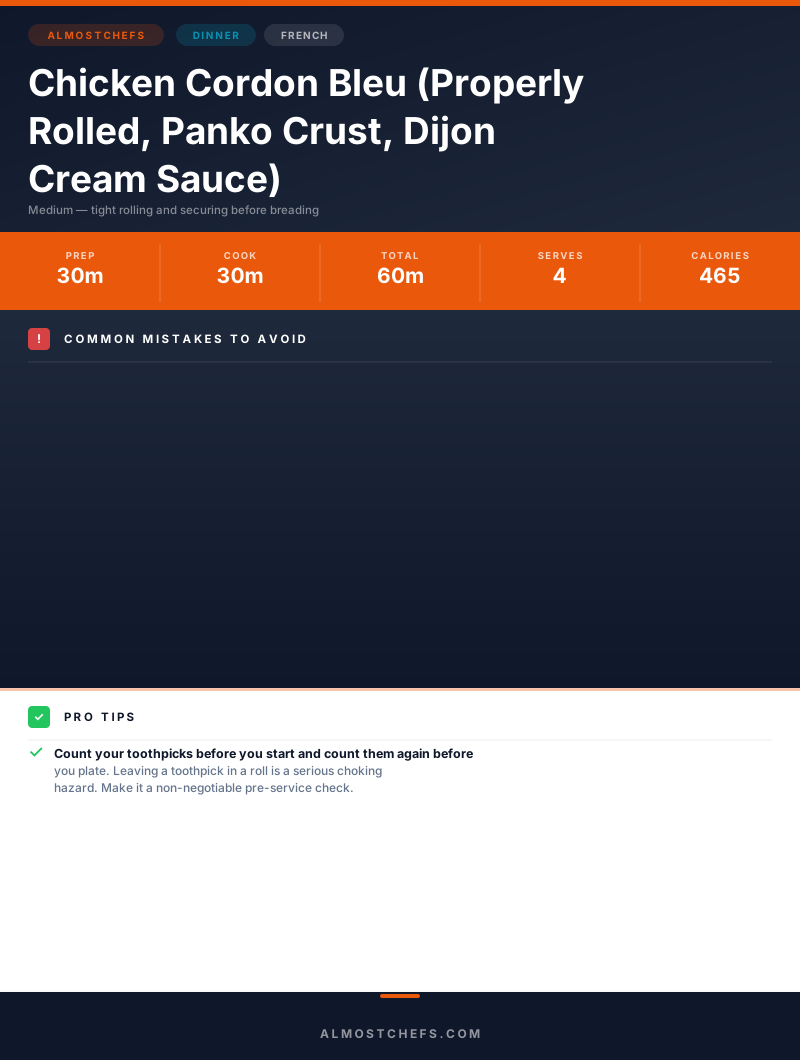
We turned everything on this page into a beautiful, flour-proof PDF cheat sheet. Print it out, stick it to your fridge, and never mess up your chicken cordon bleu (properly rolled, panko crust, dijon cream sauce) again.
*We'll email you the high-res PDF instantly. No spam, just perfectly cooked meals.
AlmostChefs Editorial Team
We translate the internet's most popular cooking videos into foolproof, beginner-friendly written recipes. We analyze multiple methods, test them in our kitchen, and engineer a single "Master Recipe" that gives you the best possible result with the least possible stress.