The Real Chicken Al Pastor Tacos (Street-Style at Home)
Smoky, achiote-red chicken thighs marinated in a dried chile and pineapple paste, seared hot until charred at the edges, and served in warm corn tortillas with raw onion, cilantro, and a fresh pineapple hit. We broke down the street technique so you can replicate it on a home stovetop without a vertical spit.
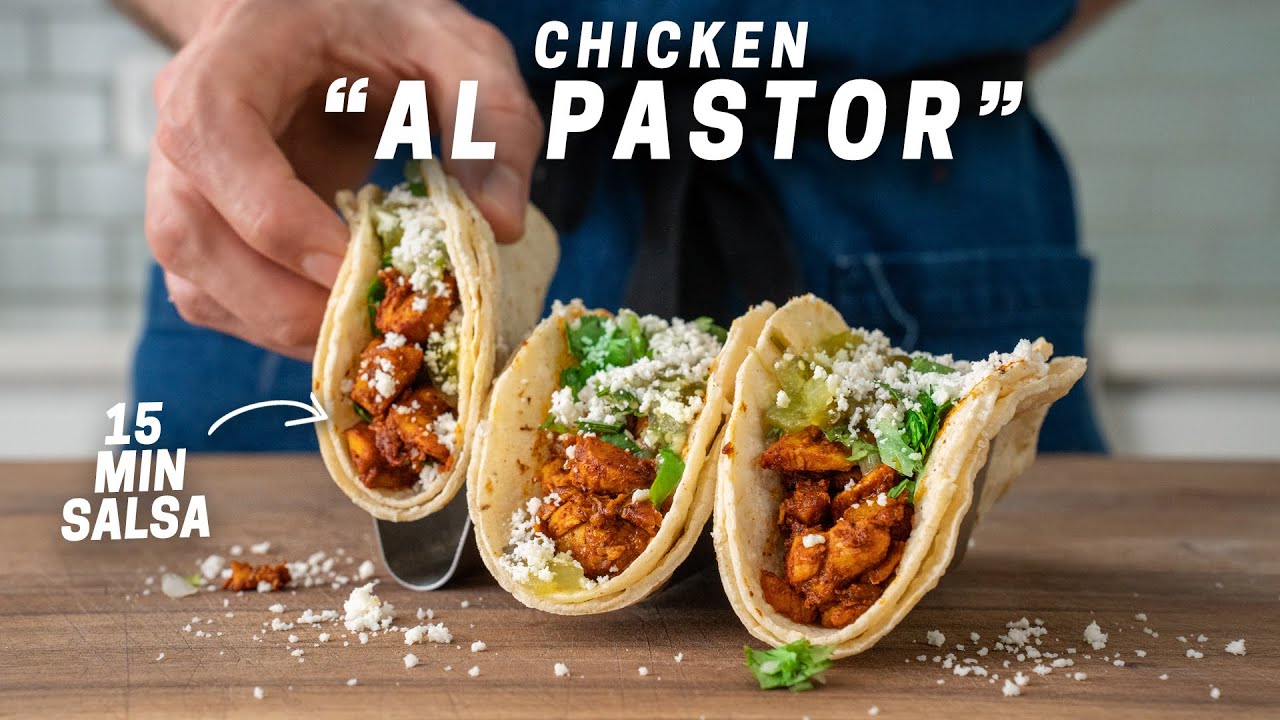
“Al pastor is the taco that Mexico invented after Lebanese immigrants brought shawarma and nobody looked back. The defining move is the achiote-and-dried-chile marinade that turns raw chicken into something deeply red, smoky, and slightly sweet — nothing like the fajita seasoning impostors sold in jars. The pineapple is not a garnish. It is an enzyme delivery system that tenderizes while adding acidity. Get both of those right and everything else falls into place.”
Why This Recipe Works
Al pastor is one of the great accidental fusions in culinary history. Lebanese immigrants arrived in central Mexico in the early twentieth century, bringing with them the shawarma tradition — marinated lamb stacked on a vertical rotating spit, shaved thin, and served in flatbread. Mexican cooks saw the technique, replaced the lamb with pork, replaced the flatbread with corn tortillas, and added a catalogue of local dried chiles and achiote that transformed a Middle Eastern classic into something entirely its own. Chicken al pastor is a further evolution, and it demands the same respect for the foundational technique: the marinade is architecture, not seasoning.
The Dried Chile Paste Is the Whole Point
Most home cooks reach for a spice packet, a jar of "al pastor seasoning," or — worse — chipotle powder and call it close enough. It isn't. The dried chile paste built from rehydrated guajillo and ancho chiles is where the flavor complexity lives. Guajillos are fruity, slightly tannic, with a thin dry heat that builds slowly. Anchos are sweeter, with raisin and tobacco undertones from their fully ripened state. Together, blended with chipotles in adobo for smoke and achiote paste for that unmistakable earthy, peppery depth, they create a marinade that is genuinely irreplaceable. No powder approximates what fresh-toasted, properly soaked dried chiles produce.
The toasting step deserves attention. Thirty to forty-five seconds in a dry pan over medium heat wakes up the volatile aromatic compounds that are essentially dormant in a dried chile. You will smell the difference immediately — raw dried chiles smell flat; toasted ones smell smoky, complex, and faintly sweet. The line between properly toasted and scorched is narrow, and a scorched chile will add bitter, acrid notes that bleed through every component of the finished taco. Watch them every second.
What Pineapple Actually Does
The pineapple in al pastor is not garnish, and it is not a flavor gimmick borrowed from Hawaiian pizza discourse. Fresh pineapple contains bromelain, a proteolytic enzyme that cleaves muscle fiber proteins — specifically myosin — creating a genuinely more tender texture in the marinated chicken. This is the same science behind using papaya or kiwi as meat tenderizers. The effect requires raw pineapple specifically: heat processing destroys bromelain, which is why canned pineapple in the marinade produces no tenderizing effect whatsoever. Use fresh pineapple in the paste; save the rest for caramelizing alongside the chicken in the pan.
The caramelized pineapple served in the finished taco is equally non-negotiable. When pineapple hits a screaming-hot cast iron skillet, its natural sugars (roughly 10g per 100g of fruit) undergo rapid Maillard and caramelization reactions, producing a jammy, sweet-acidic component that balances the heavy smoke of the chile-marinated chicken. Cold pineapple from a can does not have this. The sweetness is still there but the textural contrast and concentrated caramel depth are absent.
High Heat Is Not Optional
The char on al pastor is structural flavor, not incidental aesthetics. At the extreme heat of a vertical spit — or the surface of a cast iron pan pushed to its maximum — the Maillard reaction creates hundreds of new flavor compounds in the crust that don't exist in the interior meat. This is why al pastor tastes different from slow-cooked chile chicken even with an identical marinade. The caramelized, slightly bitter, intensely savory crust provides contrast to the juicy interior, and that contrast is the whole taco.
Medium heat doesn't produce this. It produces steam. The chicken releases its moisture, that moisture creates a low-temperature wet environment above the surface, and the meat effectively braises in its own juices rather than developing a crust. You end up with pale, soft, properly flavored chicken that tastes like it belongs in a burrito bowl, not a street taco. Pat the surface dry before it hits the pan, use a cast iron skillet or carbon steel pan preheated until smoking, and don't touch the chicken for at least four minutes after it lands.
The Assembly Is a Technique
A street taco is not a vehicle — it is a precision composition. Double-stacked corn tortillas are standard practice for structural integrity and additional corn flavor. The topping ratio matters: too much onion overwhelms, too little loses the sharp counterpoint to the smoky chicken. Cilantro provides grassy brightness. Lime provides acid that lifts every other flavor. The salsa goes last, used sparingly — a teaspoon, not a puddle. Build the taco correctly on a comal-warmed tortilla and every component does its job. Pile them on carelessly and you're eating a mess.
The entirety of this dish is the management of contrast: smoky against bright, rich against acidic, charred against fresh. That's the street taco principle. Get the marinade right, get the heat right, and the assembly takes care of itself.
Where Beginners Mess This Up
Before we start, read this. These are the 4 reasons your the real chicken al pastor tacos (street-style at home) will fail:
- 1
Using fresh chiles instead of dried: Fresh guajillo or ancho chiles have high moisture content and grassy raw flavor that doesn't cook out properly in a marinade. Dried chiles have concentrated, complex flavor developed through slow dehydration. Toast them, rehydrate them in hot water, and blend them into the paste. There is no shortcut here.
- 2
Skimping on the marinade time: The achiote paste and dried chile blend needs a minimum of 4 hours — ideally overnight — to fully penetrate the chicken thighs. A 30-minute marinade produces pale, surface-flavored meat that loses all its color the moment it hits a hot pan. Time is the ingredient you cannot substitute.
- 3
Cooking on medium heat: Al pastor gets its char from high, aggressive heat. On a vertical spit, the meat faces direct flame or infrared heat at extreme temperatures. At home, you need a smoking-hot cast iron or carbon steel pan. Medium heat steams the chicken instead of searing it and you lose the caramelized crust that is half the flavor.
- 4
Skipping the pineapple on the pan: The pineapple does two things in this recipe: bromelain in raw pineapple tenderizes the meat during marination, and caramelized pineapple cooked alongside the chicken adds sweetness that balances the smoke and acid. Serving it cold from a can is not the same.
The Video Reference Library
Want to see it in action? Here are the exact videos we analyzed and combined to build this foolproof recipe translation:
The source video for this recipe. Detailed breakdown of the dried chile paste technique and the high-heat sear method that replicates street taco char on a home stovetop.
Extended walkthrough on building the achiote-chile paste from scratch, including how to tell when dried chiles are properly toasted versus scorched — a common failure point.
Covers the finishing details that separate street tacos from home versions: double-stacking tortillas, the correct cilantro-to-onion ratio, and how to cut and caramelize pineapple for maximum sweetness.
🛠️ Core Equipment
- Cast iron skilletYou need a pan that can hold extreme heat without warping. Cast iron retains heat even when cold chicken hits the surface, which is what produces the crust. A [cast iron skillet](/kitchen-gear/review/cast-iron-skillet) is the single most important tool in this recipe.
- Blender or food processorThe dried chile paste needs to be completely smooth. A hand blender leaves fibrous chile skin in the marinade that creates texture problems in the finished taco. A proper [blender](/kitchen-gear/review/blender) produces a silky paste that coats every surface of the chicken.
- Comal or flat griddleFor warming corn tortillas directly over a flame or dry heat. A [comal](/kitchen-gear/review/comal) produces the slight char and pliability you need. Wrapping tortillas in damp paper towels and microwaving them is acceptable in an emergency and nowhere else.
- Fine-mesh sieveFor straining the rehydrated chile paste after blending, catching any remaining skin or seeds that the blender missed. Unblended solids make the marinade gritty and uneven.
The Real Chicken Al Pastor Tacos (Street-Style at Home)
🛒 Ingredients
- ✦2 pounds boneless, skinless chicken thighs
- ✦3 dried guajillo chiles, stems and seeds removed
- ✦2 dried ancho chiles, stems and seeds removed
- ✦2 chipotle peppers in adobo sauce, plus 1 tablespoon adobo sauce
- ✦2 tablespoons achiote paste
- ✦1/2 cup fresh pineapple, divided (plus extra for serving)
- ✦4 cloves garlic
- ✦1/2 white onion, roughly chopped (plus thinly sliced for serving)
- ✦3 tablespoons apple cider vinegar
- ✦1 tablespoon fresh orange juice
- ✦1.5 teaspoons dried Mexican oregano
- ✦1 teaspoon ground cumin
- ✦1/4 teaspoon ground cloves
- ✦1 teaspoon kosher salt, plus more to taste
- ✦2 tablespoons neutral oil
- ✦12 small corn tortillas
- ✦1/2 cup fresh cilantro leaves, roughly chopped
- ✦2 limes, cut into wedges
- ✦Salsa verde or salsa roja, for serving
👨🍳 Instructions
01Step 1
Heat a dry skillet over medium heat. Add the guajillo and ancho chiles and toast for 30-45 seconds per side until fragrant and slightly darkened — they should smell smoky, not burnt.
02Step 2
Transfer the toasted chiles to a bowl and cover with 1.5 cups of boiling water. Soak for 20 minutes until fully softened, then drain, reserving 3 tablespoons of the soaking liquid.
03Step 3
Add the rehydrated chiles, reserved soaking liquid, chipotles in adobo, adobo sauce, achiote paste, 1/4 cup pineapple, garlic, chopped onion, apple cider vinegar, orange juice, oregano, cumin, cloves, and salt to a blender. Blend on high for 90 seconds until completely smooth.
04Step 4
Pour the blended marinade through a fine-mesh sieve, pressing with a spoon to extract all liquid. Discard solids.
05Step 5
Score each chicken thigh with a few shallow cuts to help the marinade penetrate. Coat every surface with the chile paste, cover, and refrigerate for at least 4 hours — overnight is strongly preferred.
06Step 6
Remove the chicken from the refrigerator 30 minutes before cooking. Pat the surface lightly with paper towels to remove excess marinade that would steam rather than sear.
07Step 7
Heat a [cast iron skillet](/kitchen-gear/review/cast-iron-skillet) over high heat until smoking. Add 1 tablespoon of oil and let it just reach its smoke point.
08Step 8
Sear the chicken thighs in batches, undisturbed, for 4-5 minutes per side until deeply charred and cooked through to 165°F internal temperature. Do not crowd the pan.
09Step 9
While the last batch cooks, add the remaining 1/4 cup pineapple chunks to the pan. Sear for 2-3 minutes until caramelized with dark edges.
10Step 10
Rest the chicken for 5 minutes, then slice thinly against the grain into small, taco-sized pieces.
11Step 11
Warm corn tortillas directly on a [comal](/kitchen-gear/review/comal) or dry skillet over medium-high heat, 30 seconds per side. Stack two per taco.
12Step 12
Build the tacos: chicken slices, caramelized pineapple, thinly sliced white onion, fresh cilantro, a squeeze of lime, and salsa. Serve immediately.
Nutrition Per Serving
Estimates based on standard preparation. Adjustments alter macros.
🔄 Substitutions
Instead of Chicken thighs...
Use Chicken breast
Breast dries out faster at high heat. Reduce sear time to 3-4 minutes per side and watch the internal temperature closely. Thighs are strongly preferred for juiciness and flavor.
Instead of Achiote paste...
Use 1 tablespoon smoked paprika + 1/2 teaspoon turmeric + 1/2 teaspoon garlic powder
Approximates the color but not the earthy, peppery flavor of true achiote. Acceptable in a pinch, not a replacement.
Instead of Dried guajillo chiles...
Use New Mexico dried chiles
Similar mild heat and fruity undertones. Slightly less complex but widely available at most grocery stores.
Instead of Corn tortillas...
Use Flour tortillas
Softer texture that some prefer, but you lose the corn flavor that is part of the taco's identity. If using flour tortillas, use a single layer — they are sturdier.
🧊 Storage & Reheating
In the Fridge
Store cooked chicken in an airtight container for up to 4 days. Keep tortillas, toppings, and chicken separate — assembled tacos go soggy within an hour.
In the Freezer
Freeze cooked, sliced chicken for up to 3 months. The marinade paste itself also freezes well — portion it into ice cube trays for quick future use.
Reheating Rules
Reheat chicken in a hot cast iron skillet with a small splash of water for 3-4 minutes. This re-crisps the edges and keeps the meat from drying out. Avoid the microwave — it steams the char away.
❓ Frequently Asked Questions
What makes al pastor different from other taco meats?
Al pastor is defined by the achiote-and-dried-chile marinade, the pineapple tenderizer, and the vertical spit cooking method (or its high-heat stovetop equivalent). It traces directly to Lebanese shawarma brought to central Mexico in the early 20th century — the original dish used lamb on a vertical spit. Mexican cooks adapted it with local chiles, achiote, and pork, then chicken became a common variation. The achiote is the flavor signature nothing else replicates.
Can I make al pastor without a vertical spit?
Yes — this entire recipe is designed for that. The key is using bone-dry chicken after marinating and a cast iron pan at maximum heat. You won't get the continuous dripping fat that bastes a spit-roasted version, but the dried chile crust and achiote depth are fully achievable.
Why do my tacos taste flat even with all the right ingredients?
Two likely causes: insufficient marinade time, or medium heat instead of high. The Maillard reaction at high heat creates dozens of new flavor compounds that are the backbone of the taco's complexity. If you cooked on medium, the chicken steamed rather than seared. The char is not cosmetic — it is flavor.
Is the pineapple essential or just traditional?
Both. Bromelain, the enzyme in raw pineapple, breaks down meat proteins and creates a more tender texture during the marinade phase. It also adds acidity that brightens the heavy chile paste. Canned pineapple has been heat-processed which destroys the bromelain — use fresh pineapple in the marinade specifically.
How do I get the deep red color like street tacos?
Two things: achiote paste and sufficient marinade time. Achiote (annatto seed paste) is what turns the chicken that vivid brick red. Guajillo chiles contribute additional deep color. If your chicken looks pale after cooking, either the achiote was insufficient, the marinade time was too short, or too much paste was patted off before searing.
What salsa should I use?
Salsa verde (tomatillo-based) is the classic pairing — its brightness cuts through the rich, smoky chicken. A charred tomato-chile de arbol salsa roja is the alternative for heat seekers. Avoid thick, chunky salsas that overpower the taco. The chicken is the star; the salsa should support it.

The Science of
The Real Chicken Al Pastor Tacos (Street-Style at Home)
We turned everything on this page into a beautiful, flour-proof PDF cheat sheet. Print it out, stick it to your fridge, and never mess up your the real chicken al pastor tacos (street-style at home) again.
*We'll email you the high-res PDF instantly. No spam, just perfectly cooked meals.
AlmostChefs Editorial Team
We translate the internet's most popular cooking videos into foolproof, beginner-friendly written recipes. We analyze multiple methods, test them in our kitchen, and engineer a single "Master Recipe" that gives you the best possible result with the least possible stress.