Perfect Chamchi Gimbap (No More Soggy Tuna Leaks)
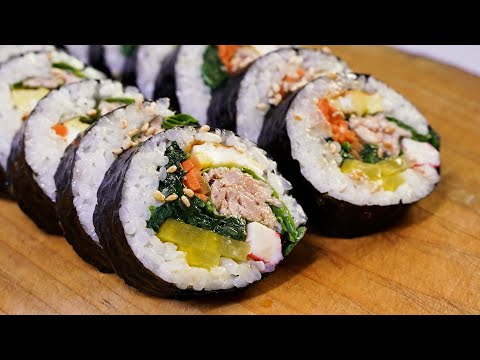
A Korean tuna rice roll packed with seasoned spinach, stir-fried carrot, egg strips, and crab stick — all wrapped in roasted seaweed. We analyzed the technique behind leak-free tuna gimbap and built one foolproof method around the perilla leaf barrier that keeps every roll clean and intact.

“Tuna gimbap has one enemy: oil. The moment wet tuna touches the seaweed, the roll goes slack, the rice slides, and your picnic becomes an apology. The fix is not draining harder. It is a single perilla leaf placed between the other fillings and the tuna — a barrier that traps oil inside the roll where it belongs. We broke down the classic Korean technique to give you clean cuts, tight rolls, and zero leaks every time.”
Why This Recipe Works
Gimbap is not sushi. The confusion is understandable — both use seaweed, rice, and fillings — but the logic behind each is completely different. Sushi is about the fish. Gimbap is about the architecture. The rice is seasoned independently. The fillings are cooked separately, cooled completely, and arranged in a specific order for structural and flavor reasons. The roll is sealed with water and cut with an oiled blade. Every step solves a specific problem. Skip one and the whole thing fails.
The Tuna Problem
Canned tuna is about 30–40% oil by weight when packed in oil, and even water-packed varieties carry more moisture than the roll can absorb. The standard advice — "drain the tuna" — is technically correct but practically insufficient. You need to press it. Hard. Against the can lid, then against paper towels, until the tuna looks almost dry before you add mayonnaise. The mayonnaise introduces just enough fat to bind the mixture; excess tuna oil does the opposite, causing it to weep outward through the rice and into the seaweed.
The perilla leaf barrier is the second half of this solution. Perilla leaves (깻잎) have a waxy surface that repels oil rather than absorbing it. Placing them directly under the tuna mixture creates a physical layer that traps oil inside the roll rather than letting it migrate outward. This is why the assembly order is specific: other fillings first, perilla leaves second, tuna last. Reverse that order and you've eliminated the entire point of the technique.
The Temperature Rule
Every Korean grandmother knows this instinctively: never roll warm. Hot or even room-temperature fillings generate steam inside the roll, and steam is the enemy of structural seaweed. The moment seaweed absorbs steam, it goes soft and loses its grip on the rice. This is why you stir-fry the spinach and carrot over high heat for as short a time as possible — you want to cook them and drive off moisture simultaneously — and then spread them on a flat surface to cool completely before touching the seaweed.
The egg sheet follows the same rule. Low heat, covered, until just set — then cooled. A flat non-stick pan is essential here for even thickness. Uneven egg strips create lumps in the roll that make the cross-section look irregular and make cutting clean slices harder.
The Rice Foundation
Korean gimbap rice is seasoned simply — sesame oil and salt — and cooked on the drier side. The ratio matters. Wet rice clings to itself and to the seaweed in ways that make clean slicing impossible. Drier, fluffier rice (고슬고슬한 밥) spreads evenly, holds its position during rolling, and separates cleanly under the knife. If your rice cooker produces sticky rice, reduce your water ratio by roughly 10% when making gimbap specifically.
Season the rice while it is still warm — salt and sesame oil distribute more evenly into warm grains — but cool it to room temperature before rolling. Warm rice seams the same problems as warm fillings.
The Cut
The knife is not optional equipment. A dull blade applied with sawing pressure tears the seaweed instead of slicing through it, compresses the filling into an asymmetric mass, and drags rice out of the cross-section. What you need is a sharp chef's knife coated with sesame oil, applied with a single confident downward stroke per cut. The sesame oil eliminates the friction between blade and sticky rice. One stroke, clean separation. Recoat every two or three cuts. That is what makes gimbap look like it came from a shop rather than a home kitchen.
The roll itself benefits from a coat of sesame oil on the outside before cutting — it adds the glossy sheen you see in professional gimbap and helps the blade glide through the seaweed without catching.
Where Beginners Mess This Up
Before we start, read this. These are the 4 reasons your perfect chamchi gimbap (no more soggy tuna leaks) will fail:
- 1
Not draining the tuna completely: Canned tuna carries more oil than you think. Press it against the lid of the can, then press it again with paper towels. Any residual oil migrates outward the moment heat hits the seaweed, turning the exterior slimy and causing the roll to unravel. Drain until the tuna is nearly dry before adding mayonnaise.
- 2
Adding fillings while they're still warm: Hot fillings steam the seaweed from the inside. The moment seaweed absorbs steam, it goes limp and loses its structural grip on the rice. Every cooked filling — spinach, carrot, egg — must cool completely to room temperature before the first roll is assembled.
- 3
Skipping the perilla leaf barrier: This is the entire technique. Perilla leaves go down last before the tuna, acting as a fat-repellent layer between the oily tuna and the seaweed. Without this barrier, tuna oil seeps through the rice and saturates the nori within minutes. With it, the roll stays tight for hours — ideal for picnics.
- 4
Cutting without sesame oil on the knife: Rice is sticky. A dry knife compresses the roll and tears the seaweed instead of slicing through cleanly. Brush sesame oil on the blade before every cut. The oil lubricates the knife path and produces the clean cross-sections that make gimbap look like it came from a Korean convenience store.
The Video Reference Library
Want to see it in action? Here are the exact videos we analyzed and combined to build this foolproof recipe translation:
🛠️ Core Equipment
- Bamboo rolling mat (gimbap mat)Provides even pressure across the full width of the roll, which is what produces a tight, round cross-section. Rolling by hand without a mat results in uneven pressure and oval-shaped slices.
- Fine-mesh sieve or colanderEssential for rinsing the blanched spinach. Three cold water rinses remove bitterness and excess salt. The sieve also makes it easier to press out all residual water, which is critical — wet spinach transfers moisture to the rice and softens the seaweed.
- Sharp chef's knifeA dull knife drags through the roll rather than slicing through it. The drag force compresses the filling and causes the seaweed to tear rather than separate. Sharpen before you start, then coat the blade with sesame oil before each cut.
- Non-stick skillet or flat panUsed for both the egg omelet and the stir-fried vegetables. A flat surface is critical for the egg sheet — you need even thickness across the entire pan so the strip widths are uniform when cut.
Perfect Chamchi Gimbap (No More Soggy Tuna Leaks)
🛒 Ingredients
- ✦100g canned tuna, drained completely
- ✦1 tablespoon mayonnaise
- ✦4 sheets gimbap seaweed (김밥용 김)
- ✦8–10 perilla leaves (깻잎)
- ✦2 crab sticks (맛살), halved lengthwise
- ✦1 medium carrot, julienned
- ✦5 large eggs
- ✦1 teaspoon cooking wine (청주)
- ✦Cooked short-grain rice, enough for 4 rolls (about 3 cups cooked)
- ✦Yellow pickled radish strips for gimbap (김밥용 단무지), 4 strips
- ✦Cooking oil for stir-frying
- ✦Sesame oil for rice, finishing, and knife
- ✦Salt to taste
- ✦1 bunch spinach (시금치)
- ✦1 tablespoon sesame oil (for spinach)
- ✦1/2 tablespoon minced garlic
- ✦1 tablespoon finely chopped green onion
- ✦1/2 tablespoon sesame seeds
- ✦Black pepper to taste
👨🍳 Instructions
01Step 1
Drain the canned tuna completely — press it against the can lid, then blot with paper towels until nearly dry. Mix with 1 tablespoon mayonnaise. Set aside.
02Step 2
Trim the bottom ends off the spinach bunch. Blanch in boiling salted water for 1 minute.
03Step 3
Transfer spinach immediately to a bowl of cold water and rinse 3 times. Squeeze out all excess moisture with both hands until the spinach is very dry.
04Step 4
Mix the squeezed spinach with 1 tablespoon sesame oil, 1/2 tablespoon minced garlic, 1 tablespoon chopped green onion, a pinch of black pepper, and 1/2 tablespoon sesame seeds. Stir-fry quickly over high heat for 30–45 seconds, then spread on a plate and let cool completely.
05Step 5
Julienne the carrot into thin matchstick strips. Stir-fry over high heat with a little cooking oil until just softened, about 1–2 minutes. Spread on a plate and cool completely.
06Step 6
Beat 5 eggs with 1 teaspoon cooking wine and a pinch of salt. Pour the entire mixture into a lightly oiled flat pan over low heat. Cover with a lid and cook until the top surface is just set, then flip once and cook for 30 more seconds. Remove and cool.
07Step 7
Slice the egg sheet into long strips wide enough to fit the gimbap roll. Halve each crab stick lengthwise.
08Step 8
Season the cooked rice with sesame oil and salt, mixing evenly. The rice should be fluffy, not wet or clumped.
09Step 9
Place a bamboo rolling mat on the work surface. Lay a seaweed sheet on it with the shiny side facing down.
10Step 10
Spread one scoop of seasoned rice across the seaweed, leaving a 2cm gap at the far edge. Spread evenly from left to right.
11Step 11
Arrange the egg strip, carrot, crab stick, pickled radish, and spinach in a horizontal line across the center of the rice. Do not add perilla or tuna yet.
12Step 12
Lay perilla leaves flat on top of the arranged fillings. Place the tuna mixture on top of the perilla leaves.
13Step 13
Using both hands, lift the near edge of the mat and roll it forward over the fillings, pressing firmly to compact the roll. Continue rolling, applying even pressure, until you reach the far edge. Brush a little water on the exposed seaweed edge and press to seal.
14Step 14
Before cutting, brush sesame oil along the length of the roll and coat your knife blade with sesame oil. Slice into 8–10 pieces with confident, single-stroke cuts — no sawing.
Nutrition Per Serving
Estimates based on standard preparation. Adjustments alter macros.
🔄 Substitutions
Instead of Canned tuna...
Use Canned salmon or canned mackerel
Drain identically. Salmon adds a slightly richer flavor. Mackerel is more pungent — reduce the quantity slightly and add extra mayonnaise to balance.
Instead of Perilla leaves (깻잎)...
Use Shiso leaves or butter lettuce
Shiso is the Japanese equivalent and works identically. Butter lettuce creates the oil barrier effectively but lacks the anise-forward flavor that makes chamchi gimbap distinctive.
Instead of Crab stick (맛살)...
Use Cucumber spears or blanched burdock root
Cucumber adds crunch and freshness. Burdock root (우엉) is the traditional vegetarian substitution used in many Korean households.
Instead of Cooking wine (청주)...
Use Dry sake or omit entirely
The cooking wine in the egg mixture reduces any eggy odor. Dry sake is an identical substitution. Omitting it is fine — the difference is subtle.
🧊 Storage & Reheating
In the Fridge
Not recommended for long storage — refrigeration hardens the rice and makes the seaweed chewy. If necessary, wrap tightly in plastic and consume within 12 hours.
In the Freezer
Gimbap does not freeze well. The rice texture degrades significantly upon thawing.
Reheating Rules
Do not reheat. Gimbap is a room-temperature food. If the rice has hardened from refrigeration, let the wrapped rolls sit at room temperature for 20–30 minutes before eating.
❓ Frequently Asked Questions
Why is my tuna gimbap soggy?
Two causes: the tuna was not drained completely before mixing with mayonnaise, or the perilla leaf barrier was skipped. Tuna oil migrates outward through the rice and saturates the seaweed within minutes. Drain until the tuna is nearly crumbly, then use perilla leaves as a barrier layer directly under the tuna. Both steps are non-negotiable.
Why does my seaweed tear when I cut the rolls?
Either the knife is dull, or you are sawing instead of slicing. Gimbap requires a sharp knife coated with sesame oil and a single downward stroke per cut. Sawing motion drags the blade across the seaweed fibers and tears them. If your knife cannot cut cleanly in one stroke, it needs sharpening.
Can I make gimbap ahead of time?
Yes — up to 4–5 hours ahead at room temperature, tightly wrapped in plastic. The fillings are best assembled after the cooking is complete but the rolling should happen as close to serving as practical. Do not slice until ready to serve — cut rolls dry out faster than whole rolls.
Why is my gimbap oval instead of round?
You are not compressing the roll firmly enough during the initial curl. When the mat first folds over the fillings, use your fingers to press downward and inward simultaneously before rolling forward. This sets the circular cross-section. Once the shape is established in the first half of the roll, the rest follows.
What does 'fluffy rice' (고슬고슬한 밥) mean?
It refers to rice cooked with slightly less water than standard, producing grains that are distinct and non-sticky. The grains should separate easily when fluffed with a rice paddle. Wet, sticky rice clumps inside the roll and makes slicing difficult. If your rice cooker produces sticky rice, reduce water by about 10% on the next batch.
Do I need a bamboo rolling mat?
Technically no, but practically yes. A bamboo mat distributes rolling pressure evenly across the full width of the roll, which is what produces a uniformly round cross-section. Rolling by hand produces uneven pressure and irregular shapes. A mat costs almost nothing and is the single most useful piece of gimbap equipment.
The Science of
Perfect Chamchi Gimbap (No More Soggy Tuna Leaks)
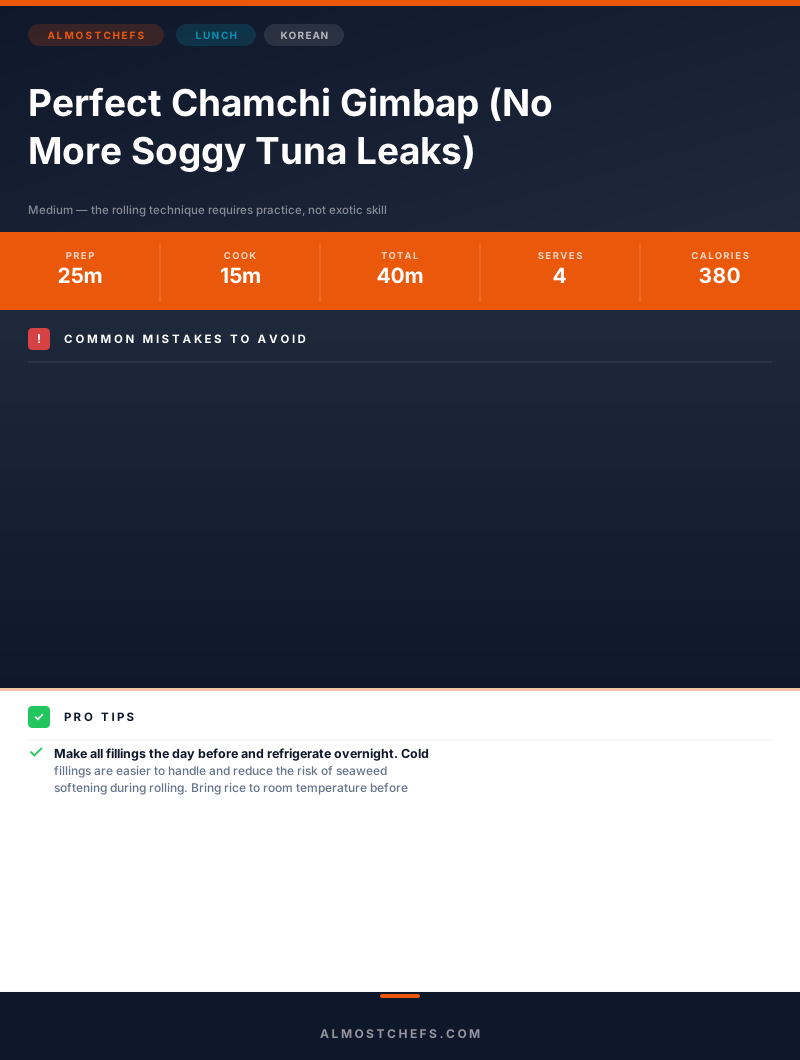
We turned everything on this page into a beautiful, flour-proof PDF cheat sheet. Print it out, stick it to your fridge, and never mess up your perfect chamchi gimbap (no more soggy tuna leaks) again.
*We'll email you the high-res PDF instantly. No spam, just perfectly cooked meals.
AlmostChefs Editorial Team
We translate the internet's most popular cooking videos into foolproof, beginner-friendly written recipes. We analyze multiple methods, test them in our kitchen, and engineer a single "Master Recipe" that gives you the best possible result with the least possible stress.