Classic Caprese Skewers (The No-Cook Appetizer That Outperforms Everything)
Fresh buffalo mozzarella, heirloom tomatoes, and basil threaded on skewers and finished with a balsamic-garlic vinaigrette. No cooking required. We broke down the technique so every bite delivers the right ratio of acid, fat, and herb — instead of a soggy, underdressed platter nobody touches.

“Caprese skewers look simple enough that most people treat them as an afterthought — grab some mozzarella, stab a tomato, done. Then they wonder why the platter is swimming in liquid, the cheese tastes like nothing, and the basil is already wilting by the time guests arrive. The difference between a platter people demolish and one they politely avoid comes down to three things: drying the mozzarella, seeding the tomatoes, and dressing at the last possible moment.”
Why This Recipe Works
Caprese skewers occupy a strange position in the appetizer hierarchy. They look effortless, they require zero cooking, and yet the failure rate at dinner parties is remarkably high. The platter fills with liquid. The basil turns black. The cheese tastes like nothing. Everyone takes one and moves on to the charcuterie board.
None of this is inevitable. It's the result of treating a precision-assembly dish like a dump-and-go situation.
The Moisture Problem
Buffalo mozzarella is stored in liquid — either brine or whey — to preserve its soft texture and prevent surface oxidation. That liquid permeates the cheese. When you cut it into cubes and leave it wet, you're building a time bomb. The moment acidic balsamic vinegar hits that surface moisture, the two liquids combine and migrate straight to the bottom of the platter, taking all the dressing flavor with them and leaving behind bland, waterlogged cheese.
The fix is paper towels and thirty seconds of your attention. Pat each cube until the surface looks matte rather than glossy. This is not about making the cheese dry — it's about removing surface liquid so the dressing adheres instead of pooling.
Tomatoes compound this problem. Heirloom tomatoes are roughly 95% water, and a disproportionate amount of that water is concentrated around the seed pockets. Seeding is not about removing flavor — the flavor lives in the flesh and skin. It's about removing a reservoir of water that has no place to go on a skewer except onto your platter.
The Dressing Architecture
The vinaigrette in this recipe is not complicated, but it requires actual emulsification. Olive oil and balsamic vinegar are physically incompatible — one is hydrophobic, one is water-based. If you just pour them both over the skewers separately, you get patches of oil and patches of vinegar, not a unified dressing. Sixty seconds of whisking forces them into a temporary emulsion where the oil breaks into small enough droplets to coat evenly.
The garlic gets minced extremely fine for the same reason — you want flavor distribution across every skewer, not a garlic chunk that ends up on one unlucky bite. A microplane or fine grater produces better results than a knife if you have one available.
Red pepper flakes serve a counterintuitive purpose. A small amount of heat doesn't read as spicy — it reads as bright. The capsaicin compounds interact with the fat in the mozzarella and the acid in the balsamic to create a more vivid overall flavor impression. This is why the finished skewers taste more vibrant than their individual components would suggest.
The Timing Constraint
The 30-second dressing window is not theater. It is the entire discipline of the dish. Balsamic vinegar is acidic enough to begin denaturing the chlorophyll in fresh basil within minutes — the leaves go from bright green to dull brown while you're still standing at the table. The same acid draws moisture out of both the mozzarella and the tomato through osmosis.
Dress the skewers, bring them to the table, and let people start eating. Don't plate them in the kitchen and carry them to a buffet table five minutes later. The window is short and the payoff for respecting it is enormous.
Ingredient Sourcing Is the Recipe
This dish has four functional ingredients: mozzarella, tomatoes, basil, and fat-acid dressing. There is no cooking process to develop flavor, no reduction to concentrate anything, no heat to hide behind. Every ingredient shows up on the plate exactly as it was when you bought it.
This means sourcing decisions that would be invisible in a braise or a curry are completely exposed here. Buffalo mozzarella over cow's milk fior di latte — the creamier fat content makes an audible difference. Heirloom tomatoes in peak season over February hothouse tomatoes — not even close. Aged balsamic over standard balsamic — one is a condiment, the other is a sauce.
A good olive oil matters here in a way it doesn't in a sauté. You'll taste it directly. Use the bottle you wouldn't normally cook with.
Get the ingredients right, handle the moisture, and dress at the last moment. That's the entire recipe.
Where Beginners Mess This Up
Before we start, read this. These are the 4 reasons your classic caprese skewers (the no-cook appetizer that outperforms everything) will fail:
- 1
Skipping the pat-dry on the mozzarella: Fresh buffalo mozzarella is stored in brine or whey. If you skip patting it dry before threading, all that stored liquid drains onto the platter the second you dress it. Within five minutes you have a puddle of diluted balsamic-water and mozzarella that tastes like wet sponge. Paper towel. Thirty seconds. Non-negotiable.
- 2
Leaving the seeds in the tomatoes: Tomato seeds are suspended in a gelatinous liquid that is almost entirely water. On a skewer, that liquid has nowhere to go but down. Scrape the seed pockets out with a small spoon when you cut your chunks. The tomato still tastes like tomato. The platter stops turning into a soup bowl.
- 3
Dressing the skewers too early: Balsamic vinegar is acidic. Acid wilts basil within minutes and begins drawing moisture out of both the mozzarella and tomato. Dress the skewers no more than 30 seconds before serving. Not five minutes before. Not when you start plating. Thirty seconds.
- 4
Using under-ripe tomatoes: This dish has four ingredients and no heat to hide behind. An under-ripe tomato tastes like red water and ruins the entire ratio. Heirloom tomatoes in season are the target. If they're out of season, use cherry tomatoes — they peak earlier and last longer than large varieties.
The Video Reference Library
Want to see it in action? Here are the exact videos we analyzed and combined to build this foolproof recipe translation:
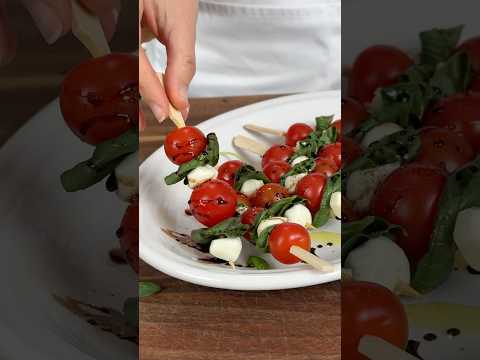
Direct demonstration of the threading sequence and vinaigrette technique. Shows exactly how the skewers should look before and after dressing.
2. Italian Appetizer Fundamentals
Overview of the principles behind Italian no-cook antipasti — balance of acid, fat, and fresh herb — that explain why each step in this recipe exists.
3. How to Pick and Store Fresh MozzarellaPractical guide to selecting buffalo mozzarella at the store and handling it at home to preserve texture and flavor until serving.
🛠️ Core Equipment
- Wooden skewers or bamboo picks ↗12 skewers minimum for 4 servings. Soak in water beforehand if you're near any heat source — dry bamboo chars. Metal cocktail picks work fine but require more threading care.
- Paper towels ↗For patting the mozzarella dry. This is the single most important piece of equipment in this recipe. Seriously.
- Small whisk or fork ↗For emulsifying the vinaigrette. Olive oil and balsamic don't combine on their own — a 60-second whisk creates a cohesive dressing that coats evenly instead of pooling.
- Serving platter with slight rim ↗Even with proper prep, some dressing will migrate. A rimmed platter contains it and makes presentation cleaner. A flat board is a recipe for a tablecloth incident.
Classic Caprese Skewers (The No-Cook Appetizer That Outperforms Everything)
🛒 Ingredients
- ✦12 wooden skewers or bamboo picks
- ✦16 ounces fresh buffalo mozzarella, cut into 1-inch cubes
- ✦3 large heirloom tomatoes, cut into 1-inch chunks, seeds removed
- ✦24 fresh basil leaves
- ✦4 tablespoons extra-virgin olive oil
- ✦2 tablespoons aged balsamic vinegar
- ✦2 cloves garlic, minced very fine
- ✦1 teaspoon sea salt
- ✦1/2 teaspoon freshly cracked black pepper
- ✦1/4 teaspoon red pepper flakes
👨🍳 Instructions
01Step 1
Soak wooden skewers in cool water for at least 15 minutes.
02Step 2
Cut the buffalo mozzarella into 1-inch cubes and pat each piece thoroughly dry with paper towels.
03Step 3
Cut the heirloom tomatoes into 1-inch chunks. Use a small spoon to scrape out the seed pockets and discard the liquid.
04Step 4
Pick 24 medium basil leaves from the stem. Choose leaves large enough to fold onto the skewer but not so large they dominate.
05Step 5
Thread each skewer: mozzarella cube, tomato chunk, folded basil leaf. Repeat until you have 3 sets per skewer. Arrange on a rimmed serving platter in a single layer.
06Step 6
Whisk together the olive oil, balsamic vinegar, minced garlic, sea salt, cracked black pepper, and red pepper flakes in a small bowl for about 60 seconds until emulsified.
07Step 7
Immediately before serving — within 30 seconds — drizzle the vinaigrette evenly over all skewers.
08Step 8
Serve immediately at room temperature.
Nutrition Per Serving
Estimates based on standard preparation. Adjustments alter macros.
🔄 Substitutions
Instead of Fresh buffalo mozzarella...
Use Fresh goat cheese or ricotta, formed into small rounds
Tangier and more assertive. Goat cheese holds its shape better on skewers and provides a sharper counterpoint to the sweet tomato. Roll into balls before threading.
Instead of Aged balsamic vinegar...
Use Apple cider vinegar or red wine vinegar
Brighter and more tart. Use slightly less — about 1.5 tablespoons — since both are more acidic and thinner than aged balsamic. The flavor profile shifts from rich-sweet to sharp-clean.
Instead of Extra-virgin olive oil...
Use Cold-pressed avocado oil
Slightly more neutral with a subtle buttery note. Comparable anti-inflammatory fat profile. Works well if you want the balsamic to dominate the dressing rather than the olive oil.
Instead of Fresh basil...
Use Fresh mint or fresh oregano
Mint reads cooler and more refreshing — good for summer outdoor serving. Oregano reads earthier and more savory — better alongside a charcuterie board context. Both hold up better than basil in heat.
🧊 Storage & Reheating
In the Fridge
Store undressed skewers in an airtight container for up to 24 hours. Once dressed, serve immediately — they do not store.
In the Freezer
Not suitable for freezing. Fresh mozzarella and tomatoes lose all texture when frozen and thawed.
Reheating Rules
This dish is served at room temperature. No reheating required or recommended. If refrigerated, allow 10-15 minutes at room temperature before serving.
❓ Frequently Asked Questions
Why is my caprese platter watery?
Two causes, almost always together: the mozzarella wasn't patted dry and the tomatoes weren't seeded. Both release significant moisture when dressed. Pat the cheese until it looks matte and scrape the seed pockets from the tomatoes before cutting.
Can I make these ahead of time?
You can thread the skewers up to 2 hours in advance and refrigerate them uncovered. Do not dress them until 30 seconds before serving. Dressing ahead wilts the basil and draws moisture out of both the cheese and tomatoes.
What's the best mozzarella to use?
Buffalo mozzarella (mozzarella di bufala) is the standard. It has a creamier, more complex flavor than cow's milk fior di latte. Both work, but buffalo is the correct choice if you can find it. Avoid low-moisture block mozzarella entirely — it's built for melting, not eating fresh.
Do I need to use heirloom tomatoes?
Not strictly — but you need ripe tomatoes with actual flavor. Heirloom varieties are the most reliable source of that in season. Out of season, cherry tomatoes outperform any large hothouse variety. An under-ripe tomato cannot be fixed by the dressing.
Can I grill the skewers?
You can, but it becomes a different dish. Grilling softens the mozzarella past its ideal texture and chars the basil. If you want to add heat, a quick 60-second pass over high flame is the maximum — you're looking for grill marks on the tomato only, not melted cheese.
Is the garlic in the dressing traditional?
Strictly traditional caprese is just olive oil, salt, and fresh basil — no garlic, no balsamic. This version uses both because they improve the dish for modern palates and party serving contexts. If you want pure tradition, skip the garlic and vinegar and use only a generous pour of excellent olive oil and flaky salt.
The Science of
Classic Caprese Skewers (The No-Cook Appetizer That Outperforms Everything)
We turned everything on this page into a beautiful, flour-proof PDF cheat sheet. Print it out, stick it to your fridge, and never mess up your classic caprese skewers (the no-cook appetizer that outperforms everything) again.
*We'll email you the high-res PDF instantly. No spam, just perfectly cooked meals.
AlmostChefs Editorial Team
We translate the internet's most popular cooking videos into foolproof, beginner-friendly written recipes. We analyze multiple methods, test them in our kitchen, and engineer a single "Master Recipe" that gives you the best possible result with the least possible stress.