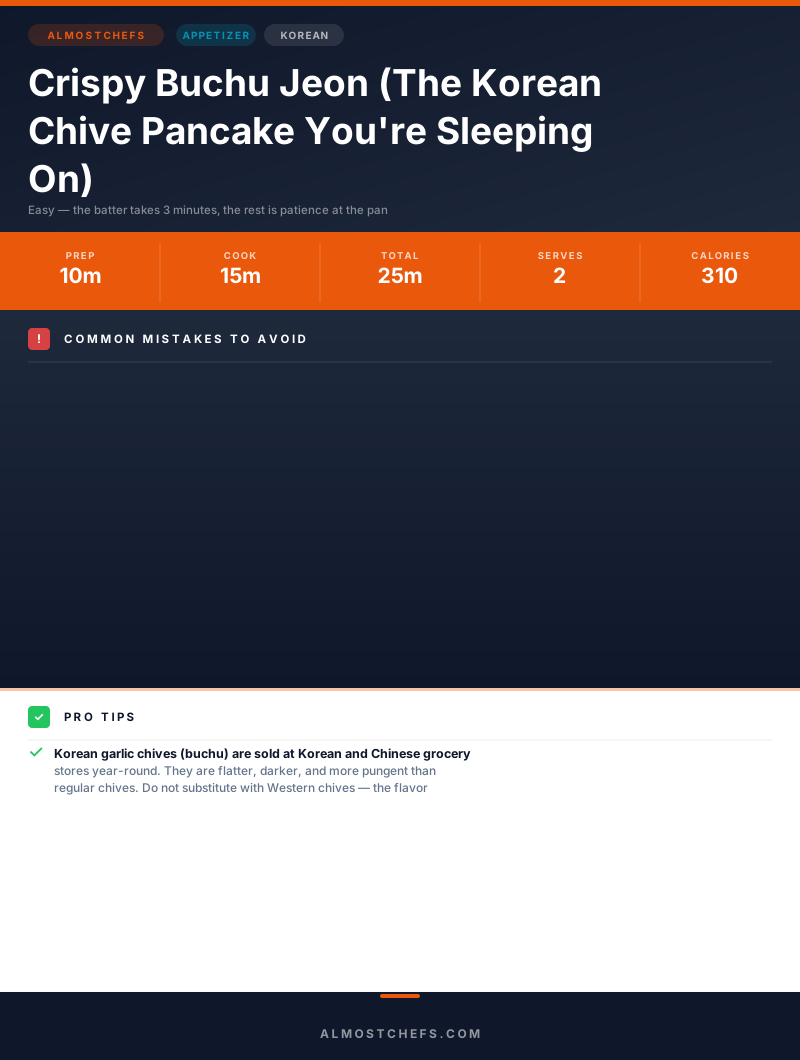
Crispy Buchu Jeon (The Korean Chive Pancake You're Sleeping On)
A savory Korean chive pancake made with garlic chives, a simple flour batter, and enough sesame oil to make the edges crackle. Faster than any other jeon, cleaner than pajeon, and wildly underrated — this is the weeknight pancake Korean home cooks reach for first.

“Pajeon gets all the attention. Kimchi jeon gets all the Instagram posts. Buchu jeon gets made on Tuesday nights when Korean home cooks want something hot, crispy, and done in 20 minutes. Garlic chives have a sharper, more mineral edge than scallions — deeper, more complex, with a faint garlic note that doesn't need reinforcement. The batter is nearly transparent, which means the pancake is more chive than dough. That ratio is the whole point.”
Why This Recipe Works
Buchu jeon occupies a specific niche in Korean home cooking that no other pancake fills. It is the 20-minute recipe, the weeknight answer, the dish that requires almost nothing and produces something genuinely worth eating. The ingredient list is short enough to memorize. The technique is almost completely forgiving. The result — thin, crackled, intensely savory, with that distinct edge where the chives char slightly against the hot fat — is one of the best things you can make in a single pan.
The Chive Question
Garlic chives are not regular chives. Western chives are mild, grassy, and interchangeable with a weak scallion. Korean garlic chives (buchu) have a bolder, more mineral flavor — somewhere between a scallion and a roasted garlic clove, with an herbal sharpness that holds up under heat rather than disappearing. They are also sturdier, which means they maintain their texture inside the batter instead of turning to mush. This matters structurally: the chives are the scaffolding. The batter is just the glue holding them in formation.
The ratio of chives to batter should favor the chives dramatically. This is not a flour pancake with chives inside it. It is a mass of chives barely bound together with enough batter to keep them from falling apart in the pan. If you find yourself with more batter than chives, you've over-measured and you should add more chives before cooking.
The Flour Architecture
The combination of all-purpose flour and rice flour is doing two separate jobs. All-purpose flour forms gluten networks when hydrated and beaten — those networks create structure, giving the pancake enough integrity to flip without tearing. Rice flour has no gluten at all. It gelatinizes during frying and produces the glass-like crispy surface that makes jeon worth eating. Without rice flour, the crust is soft and chewy. Without all-purpose flour, the pancake is too fragile to handle. The blend is not a compromise — it is the precise engineering solution.
Cold water is equally non-negotiable. Warm water accelerates gluten development and produces a tough, elastic batter. Ice-cold water retards gluten formation, keeping the batter slack and light. The same physics that make tempura batter work apply here. Cold water, minimal mixing, immediate use.
The Pan and the Fat
A cast iron skillet is the right tool because it stores enough thermal mass to recover quickly when the cold batter hits the surface. A thin stainless pan loses heat the moment the batter lands and you spend the first minute steaming rather than frying. The result is pale, soft, and disappointed.
Oil quantity is where most home cooks go conservative and ruin the result. You are shallow-frying, which means the oil should be deep enough that the edges of the pancake are visibly frying in fat, not just moistened by it. Three tablespoons across two additions is the floor. More is fine. The pancake does not absorb oil the way doughnuts do — most of it stays in the pan.
Why You Cannot Flip Early
The internal temperature of the pancake needs time to stabilize before the structure can support a flip. During the first four minutes, the bottom crust is forming while the top layer is still liquid. The chives are conducting heat upward. The egg proteins are slowly coagulating throughout. If you flip before the edges are fully set and the underside is genuinely brown, the unset top half collapses onto the spatula and you lose the pancake's shape entirely. Wait for deep color. Then flip once, decisively, and don't touch it again.
The whole enterprise takes 25 minutes. It asks almost nothing of you technically. What it does ask is that you trust the heat, resist the urge to poke and adjust and premature-flip, and serve it the moment it's cut. Jeon waits for no one.
Where Beginners Mess This Up
Before we start, read this. These are the 4 reasons your crispy buchu jeon (the korean chive pancake you're sleeping on) will fail:
- 1
Using too much batter: Buchu jeon should be thin enough that you can see the chives through the cooked surface. Thick batter smothers the chives, kills the crispiness, and turns the pancake into a doughy disk. Mix just enough batter to bind the chives — not coat them.
- 2
Crowding the pan or flipping too early: The first flip is the make-or-break moment. Wait until the edges are visibly set and the bottom is a deep, uniform golden brown. If you flip before the structure is established, the pancake tears and the chives scatter. Four minutes per side on medium-high heat is the floor, not a suggestion.
- 3
Using cold water in the batter: Ice-cold water slows gluten development and keeps the batter light. Room temperature or warm water encourages gluten formation and makes the pancake chewy and dense. Keep your mixing water cold — this is the same principle behind tempura batter.
- 4
Skimping on the oil: Jeon is a shallow-fry, not a dry sauté. You need enough oil that the edges of the pancake are actually frying in fat. A thin film produces a steamed, rubbery pancake. A proper pool of oil — covering the base of the pan — produces the crackle.
🛠️ Core Equipment
- 10 to 12-inch cast iron or stainless steel skilletCast iron holds heat evenly across the entire base, which means the pancake browns uniformly without cold spots or pale patches. Non-stick pans can work but rarely achieve the same crust depth.
- Wide flat spatulaBuchu jeon is wide and fragile before it's set. A wide spatula lets you flip the entire pancake in one confident motion. A small spatula means multiple partial flips and a torn result.
- Mixing bowl and forkDo not over-mix the batter. A fork and a bowl give you enough control to stop at a lumpy, just-combined consistency. A whisk encourages over-mixing and develops too much gluten.
Crispy Buchu Jeon (The Korean Chive Pancake You're Sleeping On)
🛒 Ingredients
- ✦200g Korean garlic chives (buchu), cut into 2-inch pieces
- ✦1/2 cup all-purpose flour
- ✦1/4 cup rice flour
- ✦3/4 cup ice-cold water
- ✦1 large egg
- ✦1/2 teaspoon fine sea salt
- ✦1/2 teaspoon sesame oil
- ✦3 tablespoons neutral oil (grapeseed or vegetable), divided
- ✦1 teaspoon toasted sesame seeds, for serving
- ✦For the dipping sauce: 2 tablespoons soy sauce, 1 tablespoon rice vinegar, 1 teaspoon gochugaru, 1/2 teaspoon sesame oil, 1/2 teaspoon sugar
👨🍳 Instructions
01Step 1
Wash and dry the chives thoroughly. Pat completely dry with a clean towel — any residual water on the chives will thin the batter and prevent crisping.
02Step 2
Whisk together flour, rice flour, and salt in a mixing bowl. Add the ice-cold water and egg. Mix with a fork until just combined — stop when the batter is barely smooth. Lumps are fine.
03Step 3
Add the chives and sesame oil to the batter. Fold gently until all the chives are coated. The batter should barely cling to the chives — thin, not thick.
04Step 4
Heat a 10 to 12-inch [cast iron skillet](/kitchen-gear/review/cast-iron-skillet) over medium-high heat until very hot. Add 2 tablespoons of neutral oil and swirl to coat the base fully.
05Step 5
Pour the batter into the pan and immediately spread it into an even round using the back of a spoon. Press lightly to ensure even contact with the pan surface.
06Step 6
Cook undisturbed for 4-5 minutes until the edges are fully set and the underside is deep golden brown. Do not press down with the spatula — let the crust form naturally.
07Step 7
Add the remaining 1 tablespoon of oil around the edges of the pancake. Flip in one confident motion using a wide flat spatula. Cook for another 4 minutes on the second side.
08Step 8
While the pancake cooks, whisk together all dipping sauce ingredients until the sugar dissolves.
09Step 9
Transfer to a cutting board and cut into rectangles or wedges. Scatter sesame seeds over the top. Serve immediately with the dipping sauce.
Nutrition Per Serving
Estimates based on standard preparation. Adjustments alter macros.
🔄 Substitutions
Instead of Korean garlic chives (buchu)...
Use Scallions (green onions)
Turns this into a simplified pajeon. The flavor is milder and less garlicky. Use the same quantity and cut into similar lengths.
Instead of Rice flour...
Use Cornstarch
Produces a similar light, crispy texture. Use the same ratio. Tapioca starch also works and produces a slightly chewier, glossier edge.
Instead of All-purpose flour...
Use Gluten-free all-purpose blend
Works well given the rice flour already in the recipe. The batter will be slightly thinner — reduce water by 1-2 tablespoons to compensate.
Instead of Egg...
Use Omit entirely
The egg adds richness and binding but is not structural. Omitting it produces a lighter, slightly more fragile pancake. Increase rice flour by 1 tablespoon to compensate for lost binding.
🧊 Storage & Reheating
In the Fridge
Store cooled pancake in an airtight container for up to 2 days. The crust will soften but the flavor remains.
In the Freezer
Freeze between layers of parchment paper for up to 1 month. Reheat from frozen — do not thaw first.
Reheating Rules
Re-crisp in a dry skillet over medium heat for 2-3 minutes per side. The microwave will steam the pancake limp — avoid it entirely.
❓ Frequently Asked Questions
What are Korean garlic chives and where do I find them?
Buchu (부추) are flat-leafed garlic chives with a distinct garlic-onion flavor more intense than Western chives. Find them in the produce section of Korean or Chinese grocery stores. They're sold in large bundles and are inexpensive year-round.
Why is my buchu jeon chewy instead of crispy?
Three likely culprits: too much batter relative to chives, insufficient oil in the pan, or the heat was too low. Jeon needs a proper shallow-fry in genuinely hot oil to develop a crust. A thin layer of oil on medium heat produces a steamed, chewy result.
Can I make the batter ahead of time?
No. The batter should be used immediately after mixing. Resting develops gluten and the chives begin releasing water into the batter, both of which compromise the final texture.
Is buchu jeon actually good for gut health?
Garlic chives contain prebiotic fibers (fructooligosaccharides) that feed beneficial gut bacteria, along with allicin compounds with documented antimicrobial properties. It's not a therapeutic dose, but regular inclusion of allium vegetables in the diet is consistently associated with better gut microbiome diversity.
Why does the recipe include both all-purpose and rice flour?
All-purpose flour provides structure and binding. Rice flour provides crispiness. All-purpose alone produces a chewy, bread-like result. Rice flour alone produces a delicate pancake that tears easily. The combination gives you a pancake that holds together and shatters at the edge.
Can I add other vegetables to the batter?
Yes, but keep additions minimal and dry. Julienned carrot, thinly sliced mushroom, or a few rings of jalapeño work well. Avoid anything with high water content (zucchini, cucumber) unless you salt and drain it first — excess water is the enemy of crust.
The Science of
Crispy Buchu Jeon (The Korean Chive Pancake You're Sleeping On)
We turned everything on this page into a beautiful, flour-proof PDF cheat sheet. Print it out, stick it to your fridge, and never mess up your crispy buchu jeon (the korean chive pancake you're sleeping on) again.
*We'll email you the high-res PDF instantly. No spam, just perfectly cooked meals.
AlmostChefs Editorial Team
We translate the internet's most popular cooking videos into foolproof, beginner-friendly written recipes. We analyze multiple methods, test them in our kitchen, and engineer a single "Master Recipe" that gives you the best possible result with the least possible stress.