The Effortless Brunch Buffet (Feed a Crowd Without Losing Your Mind)
A complete make-ahead brunch spread built for 8–12 people — fluffy scrambled eggs, crispy bacon, roasted potatoes, fresh fruit salad, and a pastry basket — engineered so everything lands on the table hot at the same time without a single panic spiral.

“Most brunch disasters are not cooking failures. They are scheduling failures. The eggs are perfect but the bacon is cold. The potatoes are still in the oven when everyone is standing around the table. The fruit got sliced too early and is now sitting in brown juice. A brunch buffet is a logistics problem dressed up as a cooking problem, and once you treat it that way, the whole thing becomes almost embarrassingly easy.”
Why This Recipe Works
Brunch is the only meal where the host reliably suffers more than the guests. Breakfast requires speed — everything goes cold in minutes. Dinner allows recovery time between courses. Brunch combines breakfast's unforgiving heat physics with dinner's expectation that you will actually sit down and enjoy yourself. The result, for most hosts, is a frantic 40-minute window of egg-scrambling, bacon-flipping, and apologizing for the cold potatoes while guests stand awkwardly in the kitchen offering to help in ways that create more obstacles than they solve.
The buffet format solves all of this. But only if you build it correctly.
The Oven Is the Foundation
The entire system depends on a single discipline: everything that can be cooked in the oven must be cooked in the oven. Bacon, potatoes, warmed pastries — all of it goes in at staggered intervals on rimmed baking sheets, and none of it requires your attention once the door closes. This frees your stove entirely for the one dish that demands real-time attention: the eggs.
Most brunch failures happen when cooks try to run parallel stove operations. Bacon in one pan, potatoes in another, eggs in a third — all while someone asks where the orange juice is. The cognitive load exceeds the available bandwidth, something gets neglected, and the cascade begins. Oven delegation is not a preference. It is a load-management strategy.
The bacon goes on the upper rack. The thick-cut strips render slowly in their own fat, developing deep color and full crispness without any flipping or monitoring. Pull them when they look like they need two more minutes — carryover heat on the pan finishes the job. Attempting to cook bacon to perfect crispness on a skillet while also managing three other dishes is how bacon gets burned.
The Parboil-Then-Roast Method
Potatoes that go directly from raw to oven produce a predictable result: steamy, waxy exterior, undercooked center, no crust. The fix is parboiling — six minutes in heavily salted water — followed immediately by vigorous shaking in the dry pot. This roughens the exterior surface into a jagged, starchy landscape that crisps dramatically in a 400°F oven.
The science is straightforward. Smooth potato surfaces have no topography for heat to grip. A roughed-up surface has hundreds of tiny peaks and edges, each of which dehydrates and browns independently. The result looks and tastes like something a good short-order cook would be proud of, and it happens unattended in the oven while you drink your coffee.
Season the potatoes aggressively. Twice. Once before roasting, once the moment they come out. Starchy foods at high heat absorb salt differently than foods cooked in water — the exterior caramelizes and forms a partial crust that resists seasoning after the fact. Hitting them immediately when they leave the oven, while the surface is still active, is the window you have.
Low-and-Slow Scrambled Eggs
The eggs are the last dish and the only one that requires your full presence. A large nonstick skillet over low heat, butter fully melted before the eggs go in, and a silicone spatula dragging gently from the edges toward the center. This takes 8-10 minutes, which feels like an eternity when you have a crowd waiting — but the physics are working in your favor. Low heat means the egg proteins set gradually and uniformly, trapping steam as large, pillowy curds rather than squeezing it out into a watery, rubbery mass.
Pull the eggs from heat while they still look slightly underdone. Transfer to a warmed ceramic dish immediately. The residual heat in the eggs and the warm dish finish the cooking without drying them out, and they will hold at ideal temperature for 10-15 minutes. This is your buffer. Use it.
Assembly Is the Finish Line
Everything lands on the table at the same time because you built the timing to make that possible. Potatoes and bacon finish together in the oven. Fruit is cut last, dressed at the moment of serving, and placed in the center of the table while the eggs are still on the stove. Pastries warm in the final 5 minutes of oven time and transfer directly to the table. The eggs go last, 60 seconds after everything else.
The result is a buffet where every dish is hot, every component is ready, and you are sitting down with your guests instead of apologizing from the kitchen doorway. That is the entire goal. Not a perfect frittata or a precisely timed hollandaise — a complete spread, hot, on the table, all at once, while you are present to enjoy it.
Where Beginners Mess This Up
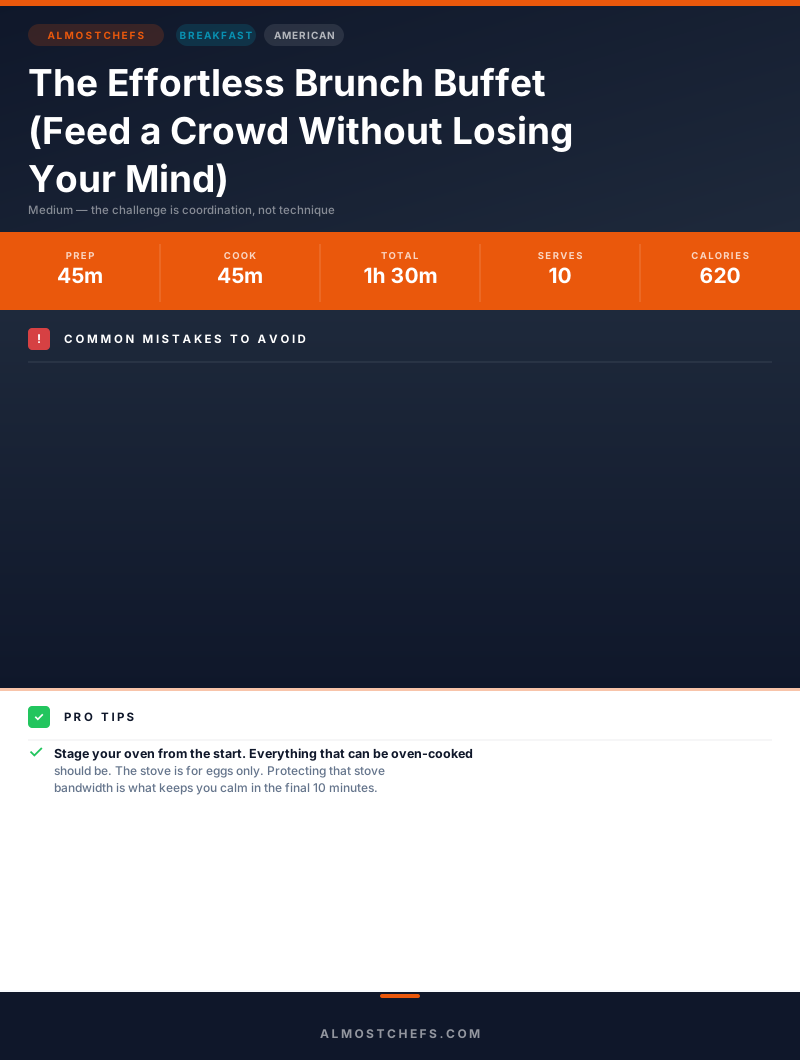
Before we start, read this. These are the 4 reasons your the effortless brunch buffet (feed a crowd without losing your mind) will fail:
- 1
Cooking eggs to order while everything else goes cold: Scrambled eggs take three minutes. They also require your full attention. If you are standing at the stove scrambling eggs while your guests are already seated and waiting, your bacon is cold, your potatoes are cold, and you are stressed. The fix: low-and-slow scrambled eggs finish in a covered pan and hold at warm for 10 minutes. Start them last, hold them with residual heat.
- 2
Under-seasoning the potatoes: Roasted potatoes need more salt than you think. They are starchy, absorbent, and cooked in dry heat — all factors that suppress salt perception. Season aggressively before roasting, then taste and season again when they come out. Under-seasoned potatoes are the silent anchor that drags down an otherwise solid spread.
- 3
Serving fruit too early: Cut fruit oxidizes fast. Strawberries weep. Melon goes slick. Bananas go brown in under 20 minutes. Cut your fruit last — after the potatoes go into the oven, not before. A squeeze of citrus juice over everything slows oxidation and adds brightness.
- 4
Trying to serve everything simultaneously off the stove: You have one stove and multiple dishes with different cooking windows. The solution is oven delegation. Bacon goes in the oven. Potatoes go in the oven. The stove handles only the eggs, which are last. Every dish that can be oven-finished should be oven-finished.
The Video Reference Library
Want to see it in action? Here are the exact videos we analyzed and combined to build this foolproof recipe translation:

🛠️ Core Equipment
- Two large rimmed baking sheetsOne for bacon, one for potatoes. Rimmed edges prevent fat from dripping into the oven and catching fire. Sheet pans with low sides also allow heat to circulate evenly, giving you crispy results without flipping.
- Large nonstick skilletFor low-and-slow scrambled eggs. A nonstick surface lets you drag the eggs gently without tearing, and makes cleanup fast when you're managing multiple dishes at once.
- Chafing dishes or oven-safe serving vesselsHot food needs to stay hot on the table. Ceramic baking dishes retain heat far longer than serving platters. If you have chafing dishes, use them. If not, preheat your serving bowls in the oven for 5 minutes before loading them.
- Instant-read thermometerFor checking bacon doneness without guessing and for verifying the egg hold temperature. Scrambled eggs should hold between 145°F and 155°F. Below that, they cool too fast. Above 165°F, they start to weep and turn rubbery.
The Effortless Brunch Buffet (Feed a Crowd Without Losing Your Mind)
🛒 Ingredients
- ✦2 pounds thick-cut bacon
- ✦3 pounds Yukon Gold potatoes, cut into 3/4-inch cubes
- ✦3 tablespoons olive oil
- ✦1.5 teaspoons smoked paprika
- ✦1 teaspoon garlic powder
- ✦1 teaspoon onion powder
- ✦18 large eggs
- ✦1/2 cup whole milk
- ✦4 tablespoons unsalted butter
- ✦1/4 cup fresh chives, finely chopped
- ✦4 cups strawberries, hulled and halved
- ✦2 cups blueberries
- ✦2 cups green grapes, halved
- ✦2 kiwis, peeled and sliced
- ✦1 navel orange, juice only (for fruit salad)
- ✦1 tablespoon honey
- ✦1 teaspoon fresh mint leaves, torn
- ✦1 pound assorted pastries (croissants, muffins, danish)
- ✦Flaky sea salt and freshly ground black pepper to taste
- ✦Hot sauce and ketchup for serving
👨🍳 Instructions
01Step 1
Preheat oven to 400°F. Line two large rimmed baking sheets with foil.
02Step 2
Parboil the cubed potatoes in heavily salted boiling water for 6 minutes until just barely fork-tender. Drain, then shake the pot vigorously to roughen the edges.
03Step 3
Toss the drained potatoes with olive oil, smoked paprika, garlic powder, onion powder, 1 teaspoon sea salt, and black pepper. Spread in a single layer on one baking sheet.
04Step 4
Lay the bacon strips in a single layer on the second baking sheet. Do not overlap.
05Step 5
Place potatoes on the lower rack and bacon on the upper rack. Roast potatoes for 35-40 minutes, flipping once at 20 minutes. Roast bacon for 18-22 minutes until deeply browned and crispy.
06Step 6
While the oven works, prepare the fruit salad. Combine strawberries, blueberries, grapes, and kiwi in a large bowl. Whisk together the orange juice and honey, pour over fruit, and toss gently. Scatter torn mint leaves over the top.
07Step 7
Arrange pastries in a linen-lined basket or on a board. If they need warming, place in the oven on a sheet pan for the last 5 minutes of potato cooking.
08Step 8
When potatoes and bacon have 10 minutes left, start the eggs. Whisk together eggs, milk, 1/2 teaspoon salt, and black pepper in a large bowl until fully combined.
09Step 9
Melt butter in a large nonstick skillet over low heat. Pour in the egg mixture. Using a silicone spatula, gently drag the eggs from the edges toward the center as they set, creating large, soft folds. Remove from heat while still slightly underdone — they will finish cooking in the pan.
10Step 10
Transfer bacon to a paper towel-lined platter to drain briefly, then move to a warmed serving dish. Transfer potatoes to a warmed bowl and season with flaky sea salt immediately.
11Step 11
Slide the eggs into a warmed serving dish. Scatter chives over the top. Set everything on the table at the same time.
Nutrition Per Serving
Estimates based on standard preparation. Adjustments alter macros.
🔄 Substitutions
Instead of Thick-cut bacon...
Use Turkey bacon or chicken sausage links
Turkey bacon requires 5 fewer minutes in the oven. Chicken sausage links can go on the same sheet pan as the bacon — they finish at roughly the same time.
Instead of Yukon Gold potatoes...
Use Sweet potatoes
Reduce parboil time to 4 minutes — sweet potatoes are softer. Add a pinch of cinnamon and cayenne to the seasoning mix for a different flavor profile.
Instead of Whole milk (for eggs)...
Use Heavy cream or oat milk
Heavy cream makes the eggs richer and slightly slower to set. Oat milk works nearly identically to whole milk in texture and produces no discernible flavor difference.
Instead of Assorted pastries...
Use Homemade biscuits or waffles
Waffles can be made in advance and kept warm in the oven at 200°F on a wire rack. Biscuits hold for up to 30 minutes wrapped in a clean kitchen towel.
🧊 Storage & Reheating
In the Fridge
Store components separately in airtight containers for up to 3 days. Scrambled eggs reheat best with a small splash of water, covered, over low heat.
In the Freezer
Bacon freezes well for up to 1 month. Potatoes can be frozen after roasting, though they lose some crispness on reheating.
Reheating Rules
Reheat potatoes in a 375°F oven for 10 minutes to restore crispness. Reheat eggs in a covered nonstick pan over very low heat with a teaspoon of butter — never microwave scrambled eggs.
❓ Frequently Asked Questions
How far ahead can I prep for a brunch buffet?
The night before: parboil and season the potatoes (hold in the fridge on the sheet pan), prep the bacon on its sheet pan, and mix the egg custard. The morning of: everything goes directly from fridge to oven or pan. You gain 20 minutes of morning calm by doing this.
How do I keep scrambled eggs warm without ruining them?
Pull them from heat while they are still slightly underdone, transfer to a warmed ceramic dish, and cover loosely with foil. They will hold at serving temperature for up to 15 minutes this way. Do not use a chafing dish over sterno — the sustained heat turns them rubbery within minutes.
What's the right amount of food to plan per person?
For a buffet where multiple dishes are present, plan for roughly 2 eggs per person, 2-3 strips of bacon, 4-5 ounces of potatoes, and one pastry. People generally eat less than you expect at a buffet because they spread their appetite across more dishes.
Can I add savory dishes like a frittata or quiche?
Yes, and a frittata is one of the best additions to a brunch buffet because it bakes unattended, holds at room temperature for up to an hour without quality loss, and can be made entirely the night before and reheated. It is the most low-maintenance hot dish you can add.
My potatoes always come out soft and steamy, not crispy. What am I doing wrong?
Two likely culprits: the potatoes were wet when they went into the oven (steam instead of roast), or they were overcrowded on the pan. Dry the parboiled potatoes completely before tossing with oil, and make sure they are in a single layer with space between each piece. Crowded potatoes steam each other.
Is a brunch buffet worth it over individual plated dishes?
For groups of 6 or more, absolutely. Plated service requires precise timing and keeps you in the kitchen during the meal. A buffet means everything is done at the same time, you are at the table with your guests, and people eat at their own pace. The cooking is easier. The experience is better.
The Science of
The Effortless Brunch Buffet (Feed a Crowd Without Losing Your Mind)
We turned everything on this page into a beautiful, flour-proof PDF cheat sheet. Print it out, stick it to your fridge, and never mess up your the effortless brunch buffet (feed a crowd without losing your mind) again.
*We'll email you the high-res PDF instantly. No spam, just perfectly cooked meals.
AlmostChefs Editorial Team
We translate the internet's most popular cooking videos into foolproof, beginner-friendly written recipes. We analyze multiple methods, test them in our kitchen, and engineer a single "Master Recipe" that gives you the best possible result with the least possible stress.