Crispy Bindaetteok (Korean Mung Bean Pancakes Done Right)
Traditional Korean savory pancakes made from freshly ground mung beans, kimchi, and bean sprouts — pan-fried until the outside shatters and the inside stays tender. We break down the batter consistency, soaking time, and oil technique that separate crispy bindaetteok from the soggy versions everyone regrets.

“Bindaetteok has a song written about it. That's how embedded it is in Korean culture. And yet most home attempts produce flat, greasy, limp pancakes that taste nothing like the crispy-edged rounds sold at Gwangjang Market. The problem is almost always the batter — too thin, too thick, or rushed through the grind. Get the mung bean paste right and the rest is just heat management.”
Why This Recipe Works
Bindaetteok is one of the oldest recorded dishes in Korean culinary history — references appear in texts from the Goryeo dynasty, more than a thousand years ago. The reason it survived that long is not nostalgia. It's that ground mung beans, when properly prepared and fried in sufficient oil, produce a pancake with a textural range that wheat flour simply cannot replicate: crisp and lacquered on the outside, dense and slightly chewy within, with the gentle earthiness of legumes running through every bite.
The failure mode that kills modern home attempts is treating this like a standard pancake recipe. It is not. The mung bean paste is not batter in any conventional sense. It is a ground legume suspension that fries closer to a bean cake than a crepe. Every decision in the recipe — soak time, grind thickness, oil depth, frying temperature — exists to serve that structural reality.
The Grinding Stage Is the Recipe
Everything downstream depends on getting the mung bean paste right. Soaked beans go into a blender with a measured amount of water, and the goal is thick: the kind of thick where you could mound it on a spoon and it holds a shape for several seconds before slumping. If the paste flows off the blender blade freely when you open the lid, you've already gone too far.
Why does this matter so much? Because the mung bean starch is the binder. There are no eggs in traditional bindaetteok, no wheat flour to hold things together. The ground beans bind to themselves through starch gelatinization during frying. A thick paste has high starch concentration — it sets quickly in hot oil and creates a coherent structure. A thin paste takes too long to set, spreads too wide, absorbs excess oil before a crust can form, and produces a greasy disc that falls apart when you try to flip it.
The additional water gets added gradually after the sprouts and kimchi are folded in, bringing the batter to a viscosity that's just barely ladle-able. This is the only moment where you have real control over final batter consistency — use it carefully.
Kimchi as Ingredient, Not Topping
Rinsing the baechu kimchi before folding it into the batter is a technique step, not a preference. Intensely fermented kimchi brings enough acidity and salt to overwhelm the mung bean base if used straight. One rinse and a hard squeeze brings it into balance. The fermented character remains — it's supposed to be there — but it becomes a supporting note rather than the entire flavor.
Chopping the kimchi small before adding matters too. Large pieces create structural weak points in the pancake, areas where the batter thins out around a dense kimchi chunk. Small pieces distribute evenly and become integrated into the paste rather than embedded in it.
The Oil Is Doing Real Work
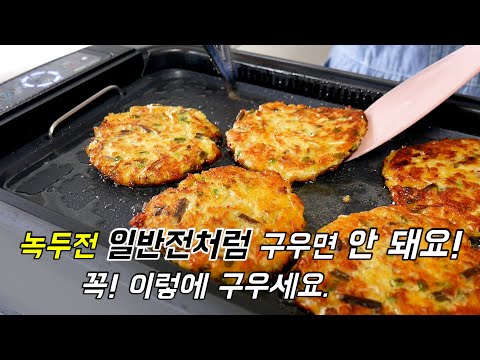
Traditional bindaetteok at Gwangjang Market gets cooked on wide flat griddles in what is, by any home cook standard, an uncomfortable amount of oil. The oil is not incidental — it is the cooking medium. It conducts heat to the sides of the pancake, not just the bottom surface, creating a crust that wraps around each round rather than appearing only on the contact side.
A cast iron skillet at home gets you closer to this than any other option. The mass holds temperature when cold batter hits the surface — thin pans drop temperature immediately, which stalls the Maillard reaction and lets the batter absorb oil before crust formation begins. Keep the heat at medium-high, keep the oil hot, and do not crowd the pan.
The flip timing is readable if you know what to look for: the top surface of the pancake will transition from shiny and wet to matte and dry as the heat works up through the interior. That matte appearance — coupled with visible golden-brown color at the edges — is the signal. Flip once. Don't fidget with it.
Serve immediately. Bindaetteok does not hold. The crust softens within minutes as internal steam works outward. The window between the pan and the table is when this dish is at its peak, and that window is short.
Where Beginners Mess This Up
Before we start, read this. These are the 4 reasons your crispy bindaetteok (korean mung bean pancakes done right) will fail:
- 1
Skipping the full soak: Mung beans need enough time in water to soften so the skins rub off cleanly and the beans grind into a smooth, starchy paste. Under-soaked beans produce a gritty batter with poor binding — the pancakes fall apart in the pan and never achieve the chewy-crisp interior texture that defines good bindaetteok.
- 2
Grinding the batter too thin: The ground mung bean mixture should be thick — closer to hummus than pancake batter. When you add water gradually during grinding, stop before it becomes pourable. The batter thins further when you fold in the kimchi and sprouts. If it's already loose at the grinding stage, the final pancakes will spread too thin and steam instead of fry.
- 3
Using too little oil: Bindaetteok is not a low-oil dish. The pan needs a generous layer of hot oil to create the shatteringly crisp exterior. Thin-oiling a nonstick pan in the name of health produces pale, soft pancakes. Use enough oil to come about a third of the way up the sides of the pancake during frying.
- 4
Rinsing the kimchi but keeping it wet: Rinsing baechu kimchi once before adding it controls excess salt and prevents the pancake from becoming overwhelmingly sour. But if you don't squeeze out the moisture after rinsing, you're injecting water directly into the batter. Squeeze the kimchi firmly in your hands before chopping and folding it in.
The Video Reference Library
Want to see it in action? Here are the exact videos we analyzed and combined to build this foolproof recipe translation:
🛠️ Core Equipment
- Blender or food processorYou need real grinding power to break down soaked mung beans into a smooth, thick paste. A standard blender handles this well. An immersion blender will struggle with the thick consistency — don't try it.
- Heavy cast iron or carbon steel skilletEven heat across the entire pan surface is what gives you uniform golden crust edge to edge. Thin skillets create hot spots that burn the center while the edges stay pale. A [cast iron skillet](/kitchen-gear/review/cast-iron-skillet) is the closest home approximation of the commercial griddles used by street vendors.
- Fine-mesh sieveFor draining the soaked mung beans before grinding. You want the beans wet but not waterlogged — draining through a sieve lets you control exactly how much liquid goes into the blender.
- LadleConsistent portion size means consistent cooking time. Use a ladle to drop equal amounts of batter into the oil rather than spooning or pouring freehand. Each pancake should be roughly the same thickness so they all finish at the same time.
Crispy Bindaetteok (Korean Mung Bean Pancakes Done Right)
🛒 Ingredients
- ✦500g whole nokdu (mung beans), soaked until skins slip off
- ✦100g mung bean sprouts (sukju namul)
- ✦200ml water for grinding, plus up to 200ml additional water for batter consistency
- ✦1 cup baechu kimchi, rinsed once and squeezed dry
- ✦Salt to taste
- ✦Neutral cooking oil for frying (enough for a generous layer in the pan)
👨🍳 Instructions
01Step 1
Place the mung beans in a large bowl and cover with cold water. Soak for at least 4 hours, or overnight. The beans are ready when the skins rub off easily between your palms.
02Step 2
Drain the soaked mung beans through a fine-mesh sieve. Working in batches with your hands or by rubbing against the sieve, remove as much of the green skin as possible. The skins are bitter — you want the pale yellow interiors.
03Step 3
Rinse the baechu kimchi under cold water once to reduce excess salt and acidity. Squeeze firmly to remove as much moisture as possible, then chop roughly into small pieces. Set aside.
04Step 4
Add the drained mung beans to a blender with 200ml water. Blend on high until the mixture becomes a thick, smooth paste — it should hold its shape when scooped with a spoon, not flow freely.
05Step 5
Transfer the ground mung bean paste to a large bowl. Add the mung bean sprouts and mix to combine.
06Step 6
Add the squeezed kimchi to the bowl. Begin folding everything together, adding additional water in small amounts until the batter is thick but just barely pourable — it should fall off a spoon in slow, heavy ribbons, not run off freely.
07Step 7
Season with salt, tasting as you go. The kimchi contributes significant salt already, so add cautiously.
08Step 8
Heat a generous amount of neutral oil in a heavy skillet over medium-high heat until shimmering. The oil should cover the bottom of the pan to a depth of about 3-4mm.
09Step 9
Ladle portions of batter into the hot oil, spreading each gently into a round about 10-12cm in diameter and roughly 1cm thick. Do not crowd the pan — cook 2-3 at a time maximum.
10Step 10
Fry undisturbed for 3-4 minutes until the bottom is deeply golden brown and the edges look set. The top surface will look dry and matte when it's ready to flip.
11Step 11
Flip carefully with a wide spatula. Cook the second side for another 3-4 minutes until equally golden. The pancakes should feel firm when pressed lightly with the spatula.
12Step 12
Transfer to a wire rack or paper-towel-lined plate. Serve immediately — bindaetteok is at peak texture within 5 minutes of leaving the pan.
Nutrition Per Serving
Estimates based on standard preparation. Adjustments alter macros.
🔄 Substitutions
Instead of Whole nokdu (mung beans)...
Use Pre-ground mung bean flour (nokdu garu)
Reduces prep time dramatically but the texture is noticeably less chewy. The ground flour doesn't bind as well as freshly processed beans, so the pancakes tend to be more delicate and prone to breaking. Add an egg to the batter if using flour to improve binding.
Instead of Baechu kimchi...
Use Kkakdugi (radish kimchi), chopped fine
Less traditional but adds a pleasant crunch where regular kimchi adds chew. Squeeze out moisture equally aggressively.
Instead of Mung bean sprouts...
Use Soybean sprouts, blanched and roughly chopped
Soybean sprouts are larger and more robust. Blanch briefly before adding to control their texture — raw soybean sprouts stay too firm through the fry time.
Instead of Neutral cooking oil...
Use Refined sesame oil or a blend of neutral oil with a splash of sesame
Pure sesame oil has a low smoke point and will burn at the temperatures needed for a crispy crust. Use refined (not toasted) sesame oil only, or mix toasted sesame oil in at a 1:4 ratio with a neutral oil.
🧊 Storage & Reheating
In the Fridge
Store cooked pancakes in an airtight container for up to 2 days. They will soften in storage — plan to re-crisp them before serving.
In the Freezer
Freeze cooked bindaetteok in a single layer on a baking sheet first, then transfer to a freezer bag. Keeps for up to 1 month. Reheat directly from frozen in a dry skillet.
Reheating Rules
Re-fry in a dry skillet over medium heat for 2-3 minutes per side until crispy again. The microwave is not suitable — it steams them into softness.
❓ Frequently Asked Questions
Why are my bindaetteok falling apart in the pan?
The batter is too thin or the oil isn't hot enough. If the batter flows like water when ladled into the pan, it won't hold together. The mung bean paste should be thick from the grinding stage. Also confirm your oil is properly hot before adding batter — cold oil means slow cooking, which means the batter spreads and breaks before it sets.
Do I have to remove the mung bean skins?
You should remove most of them, yes. The skins have a bitter, slightly astringent flavor that competes with the earthy richness of the mung bean interior. You don't need to achieve 100% skin removal — get most of them and move on.
Can I make bindaetteok without kimchi?
You can. Traditional versions sometimes include only pork, vegetables, or seafood without kimchi. Kimchi adds fermented depth and a small amount of acid that lifts the overall flavor. Without it, season the batter more carefully with salt and consider adding a few drops of rice vinegar to compensate.
How thick should each pancake be?
About 1cm thick before frying. Thinner than that and the inside cooks out before the crust develops. Thicker than 1.5cm and the interior stays raw by the time the exterior is done. Consistent thickness comes from using the same ladle portion each time.
Why does my batter smell slightly fermented or sour?
This is normal if you soaked the mung beans for a long time, especially in warm conditions. A slight fermented note in the raw batter is fine and actually adds complexity to the finished pancake. If the batter smells strongly off or slimy, discard it and start fresh.
Is bindaetteok the same as pajeon?
No. Pajeon is made from a wheat flour and egg batter with green onions as the primary ingredient. Bindaetteok uses no wheat flour — the binder is the ground mung bean paste itself, which gives it a denser, chewier texture and a more protein-forward flavor. They are both Korean savory pancakes but built on completely different foundations.
The Science of
Crispy Bindaetteok (Korean Mung Bean Pancakes Done Right)
We turned everything on this page into a beautiful, flour-proof PDF cheat sheet. Print it out, stick it to your fridge, and never mess up your crispy bindaetteok (korean mung bean pancakes done right) again.
*We'll email you the high-res PDF instantly. No spam, just perfectly cooked meals.
AlmostChefs Editorial Team
We translate the internet's most popular cooking videos into foolproof, beginner-friendly written recipes. We analyze multiple methods, test them in our kitchen, and engineer a single "Master Recipe" that gives you the best possible result with the least possible stress.