Hearty Beef Barley Soup (The One-Pot Weeknight Fix)
A rich, slow-simmered soup of tender beef chuck, pearl barley, and root vegetables in a deep savory broth. We analyzed the most-watched YouTube methods and common home cook failures to build a foolproof technique that delivers restaurant-quality depth from a single pot.

“Beef barley soup sounds straightforward until you make it and realize the broth tastes thin, the beef is chewy, and the barley has turned to paste. The difference between a bowl that warms you from the inside and one that's just hot vegetables comes down to three things: a proper sear on the beef, patience with the simmer, and knowing when to add the barley. We broke down the most-watched methods to give you the one technique that works every time.”
Why This Recipe Works
Beef barley soup is one of those dishes that looks foolproof on paper and turns out disappointing anyway. Chewy beef. Gluey barley. Flat broth that tastes like diluted stock. The bones of the recipe are simple — meat, grain, vegetables, liquid — but the execution has three specific points where home cooks reliably go wrong. Fix those three points and the soup takes care of itself.
The Sear Is Not Optional
Every recipe for braised or stewed beef tells you to sear first. Most home cooks do it halfheartedly — toss all the beef in at once, let it steam in its own moisture, call it close enough. It is not close enough.
The Maillard reaction requires two things: high surface temperature and dry meat. When you crowd the pan, the beef releases moisture that drops the pan temperature below 300°F and traps the meat in steam. The surface turns grey and the flavor compounds that make seared beef taste complex and deep never form. What you lose is not just color — it's the fond, the dark sticky layer on the bottom of the pot that dissolves into your broth during the simmer and gives it the kind of depth that takes hours to build any other way.
Work in batches. Let each piece sit undisturbed for two full minutes before checking. If it pulls away cleanly, it's ready to flip. If it sticks, it's not done developing its crust yet.
The Simmer Temperature Controls Everything
Chuck is an inexpensive cut because it contains significant collagen — the connective tissue that runs through the muscle. Collagen is what makes chuck tough when it's undercooked and silky when it's done right. The conversion of collagen to gelatin happens slowly at sustained temperatures around 180-190°F. A boil runs at 212°F and pushes the muscle fibers to seize and tighten, squeezing moisture out of the meat and turning it rubbery.
The difference between a lazy simmer and a hard boil is a few degrees and a few bubble patterns. At the right temperature, you should see a bubble break the surface every few seconds — lazy, intermittent, unhurried. The broth should barely move. This is the temperature that makes cheap beef taste expensive given enough time.
Barley Is a Timer, Not an Ingredient
Pearl barley's starch absorbs liquid continuously for as long as it's in contact with hot broth. Add it at the start of a 90-minute simmer and you'll end up with a thick, gluey mass that's absorbed half your broth and lost all its individual texture. The goal is for the barley and the beef to finish cooking at the same moment — tender beef at 75 minutes, fully cooked barley at roughly the same window. That's why both go in together after the aromatics are built.
If you're adapting this for a slow cooker, the math changes — add barley in the last 45 minutes on low, or the last 30 on high.
Building the Broth
The combination of low-sodium beef broth and beef stock is deliberate. Broth gives seasoned depth; stock gives body through gelatin and collagen. Using all broth produces a thin, salty result. Using all stock produces a rich but flat one. The two together produce a broth that coats the back of a spoon without tasting processed.
The diced tomatoes are not incidental. Their acidity balances the richness of the beef fat, their natural sugars add body, and their liquid contributes to the broth. Don't drain them — the juice is part of the recipe.
A Dutch oven is the right pot for this job. Its thick walls distribute heat without hot spots, its tight-fitting lid controls evaporation precisely, and its depth accommodates the full volume of broth without risk of splashing during the simmer. A thin stockpot produces scorched patches on the bottom by the 45-minute mark.
The spinach goes in last — two to three minutes before serving. Long-simmered spinach turns to sludge and loses its color. Add it late and it stays vibrant and contributes texture. The fresh parsley is the same principle: it's not a garnish, it's a flavor component that needs to stay raw to do its job.
Where Beginners Mess This Up
Before we start, read this. These are the 4 reasons your hearty beef barley soup (the one-pot weeknight fix) will fail:
- 1
Skipping the sear: Browning the beef in batches without crowding the pan is not optional. The Maillard reaction builds a fond on the bottom of the pot — that dark, sticky layer of caramelized proteins and sugars is the foundation of your broth's flavor. Skip it and you get grey, boiled beef in watery stock. Do it right and every cup of broth carries that depth.
- 2
Adding barley too early: Pearl barley absorbs liquid aggressively. Add it at the start and it will soak up your broth and turn into a starchy, gluey mass by the time the beef is tender. Add it when the beef still needs another hour, and they finish together. Add it too late and the barley is undercooked. The timing in this recipe is calibrated — trust it.
- 3
Simmering at a boil: A hard boil makes beef tough. The collagen in chuck needs sustained low, wet heat to convert to gelatin — that process happens around 180–190°F, well below a boil. A gentle simmer with just a few lazy bubbles breaking the surface is what turns a cheap cut tender in 75 minutes.
- 4
Under-seasoning the broth: Low-sodium broth is the right call for health, but it requires you to season aggressively at the end. Taste before serving and don't be shy with salt. A flat broth makes every other ingredient taste flat too.
The Video Reference Library
Want to see it in action? Here are the exact videos we analyzed and combined to build this foolproof recipe translation:
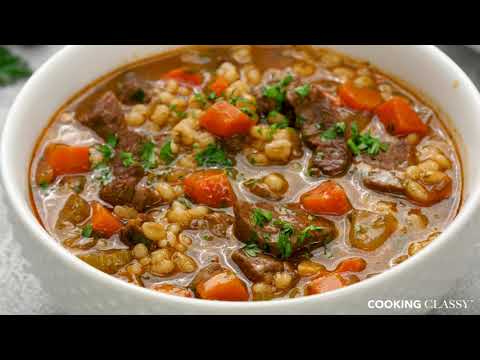
The primary reference for this recipe. Clear demonstration of batch searing technique and how to read the simmer correctly — crucial for understanding why heat control matters more than any single ingredient.
2. How to Build Soup Flavor from Scratch
Deep dive into fond development and broth building. Explains the chemistry behind why deglazing the pot after searing unlocks flavor compounds that would otherwise stay stuck to the pan.
3. One-Pot Beef Soups — Pro TipsCovers barley timing, seasoning strategy, and how to adjust final consistency. Useful for understanding how to adapt the recipe for different pot sizes and stove outputs.
🛠️ Core Equipment
- Dutch oven or heavy-bottomed soup pot ↗Even heat distribution is critical for both the initial sear and the long simmer. A thin pot creates hot spots that scorch the bottom during the 75-minute cook. A [Dutch oven](/kitchen-gear/review/dutch-oven) is the ideal vessel — thick walls, tight lid, handles that stay cool.
- Slotted spoon or spider strainer ↗For transferring seared beef batches to a plate without carrying hot oil with them. Keeping the beef separate between batches ensures the pan temperature stays high enough to sear the next round rather than steam it.
- Ladle ↗A wide, deep ladle gets every component — beef, barley, vegetables, broth — in each bowl. A narrow ladle means some people get all broth and some get all solids.
- Large plate or sheet pan for resting seared beef ↗The beef releases juices as it rests. Those juices go back into the pot when you return the meat. Don't skip this — it's essentially free flavor.
Hearty Beef Barley Soup (The One-Pot Weeknight Fix)
🛒 Ingredients
- ✦2 tablespoons extra virgin olive oil
- ✦1.5 pounds lean beef chuck, cut into 1-inch cubes
- ✦1 large yellow onion, finely diced
- ✦3 large carrots, peeled and cut into 1/2-inch rounds
- ✦3 celery stalks, sliced into 1/2-inch pieces
- ✦4 garlic cloves, minced
- ✦3/4 cup pearl barley
- ✦8 cups low-sodium beef broth
- ✦2 cups beef stock
- ✦1 can diced tomatoes (14.5 ounces), undrained
- ✦2 medium russet potatoes, cut into 1/2-inch cubes
- ✦2 dried bay leaves
- ✦1 teaspoon dried thyme
- ✦1 teaspoon dried oregano
- ✦1/2 teaspoon black pepper
- ✦1 teaspoon sea salt, plus more to taste
- ✦2 cups fresh spinach, chopped
- ✦2 tablespoons fresh parsley, chopped
👨🍳 Instructions
01Step 1
Heat the olive oil in a large Dutch oven over medium-high heat until shimmering, about 1 minute.
02Step 2
Season the beef cubes generously with salt and pepper. Working in 2-3 batches, brown them on all sides without crowding the pan, about 4-5 minutes per batch. Transfer each batch to a plate.
03Step 3
Reduce heat to medium. Add the diced onion, carrot, and celery to the pot, stirring frequently until softened and fragrant, about 6-7 minutes.
04Step 4
Add the minced garlic and stir constantly for about 1 minute until fragrant.
05Step 5
Return the browned beef and any accumulated juices back to the pot. Pour in the beef broth and stock, scraping the bottom of the pot to release all the browned bits.
06Step 6
Stir in the pearl barley, diced tomatoes with their juices, diced potatoes, bay leaves, thyme, and oregano. Bring to a boil.
07Step 7
Once boiling, reduce heat to low and cover partially with a lid. Simmer gently for 1 hour to 1 hour 15 minutes, until the beef is fork-tender and the barley is cooked through.
08Step 8
Taste and adjust seasoning with salt and pepper. Stir in the chopped spinach and fresh parsley.
09Step 9
Simmer for another 2-3 minutes until the spinach is fully wilted and bright green.
10Step 10
Remove bay leaves. Ladle into bowls and serve hot.
Nutrition Per Serving
Estimates based on standard preparation. Adjustments alter macros.
🔄 Substitutions
Instead of Pearl barley...
Use Steel-cut oats or farro
Steel-cut oats soften faster — reduce simmer time by 15 minutes and expect a slightly creamier broth. Farro holds its chew and is nearly identical in texture to barley with higher protein content.
Instead of Beef chuck...
Use Lean ground beef or sirloin tips
Ground beef breaks apart into the broth — cook for 5-7 minutes instead of 75. Sirloin tips remain as cubes but cook faster; check for tenderness at 45 minutes.
Instead of Russet potatoes...
Use Sweet potatoes or cauliflower florets
Sweet potatoes add subtle sweetness and beta-carotene. Cauliflower reduces carbs without losing the heartiness — add it 20 minutes before the end of the simmer so it doesn't disintegrate.
Instead of Fresh spinach...
Use Kale or Swiss chard, chopped
Kale needs 5 extra minutes of simmering to fully tenderize. Swiss chard wilts quickly like spinach but adds a slightly earthier, more mineral flavor.
🧊 Storage & Reheating
In the Fridge
Store in an airtight container for up to 4 days. The barley will continue absorbing broth — add a splash of stock when reheating to loosen it back up.
In the Freezer
Freeze in individual portions for up to 3 months. Leave out the potatoes if you plan to freeze — they turn mealy when thawed. Add freshly cooked potatoes when reheating.
Reheating Rules
Reheat on the stovetop over medium-low with a splash of broth or water, covered, until steaming through. Microwave works but stir halfway to avoid hot spots.
❓ Frequently Asked Questions
Why is my beef still tough after an hour?
Chuck needs sustained low, wet heat to break down its collagen into gelatin. If you simmered at too high a heat — a rolling boil rather than a lazy simmer — the muscle fibers tighten instead of relax. Drop the heat lower than you think necessary and give it another 20-30 minutes. Also check that you're using chuck specifically, not a leaner cut like round or sirloin, which won't tenderize the same way.
My barley turned to mush. What happened?
You either added it too early or simmered with the lid fully sealed, trapping excess moisture. Pearl barley absorbs liquid continuously — the timing in this recipe accounts for the 75-minute simmer. If you adjusted the cook time and forgot to adjust when the barley went in, it over-hydrated.
Can I make this in a slow cooker?
Yes, with one condition: still sear the beef first in a skillet. Don't skip it and dump raw beef into the slow cooker — you'll lose the entire flavor foundation. After searing and softening the aromatics, transfer everything to the slow cooker and cook on low for 7-8 hours or high for 4-5 hours.
How do I make the broth richer without adding more sodium?
Add a parmesan rind during the simmer, deglaze with a splash of dry red wine after the sear before adding the broth, or stir in a tablespoon of tomato paste with the aromatics. Each adds depth through umami or acidity rather than salt.
Can I use quick-cook barley?
You can, but add it in the last 10-15 minutes of cooking rather than with the other ingredients. Quick-cook barley has been pre-processed and will turn to paste if simmered for 75 minutes.
What's the difference between beef broth and beef stock?
Broth is made primarily from meat and is seasoned — it tastes good on its own. Stock is made from roasted bones, uncooked vegetables, and no salt — it's richer in gelatin and collagen but bland alone. Using both gives you the seasoned depth of broth and the body of stock. If you only have one, use low-sodium broth for the full 10 cups.
The Science of
Hearty Beef Barley Soup (The One-Pot Weeknight Fix)
We turned everything on this page into a beautiful, flour-proof PDF cheat sheet. Print it out, stick it to your fridge, and never mess up your hearty beef barley soup (the one-pot weeknight fix) again.
*We'll email you the high-res PDF instantly. No spam, just perfectly cooked meals.
AlmostChefs Editorial Team
We translate the internet's most popular cooking videos into foolproof, beginner-friendly written recipes. We analyze multiple methods, test them in our kitchen, and engineer a single "Master Recipe" that gives you the best possible result with the least possible stress.