Beef and Broccoli (Velveted Flank Steak, Oyster Sauce Glaze, Wok Method)
Chinese-American beef and broccoli built correctly — flank steak velveted with baking soda, blanched broccoli, and an oyster-soy-sesame sauce that glazes rather than pools. The velveting is the technique.

“Most beef and broccoli fails at the beef. It's chewy, it's gray, and it has nothing to do with how the restaurant version tastes. The difference is velveting — a baking soda marinade that alters the surface chemistry of the meat and delivers the silky, tender texture you've been trying to replicate. Everything else is secondary.”
Why This Recipe Works
Beef and broccoli is one of the most ordered Chinese-American dishes in the country, and also one of the most consistently disappointing when made at home. The beef is chewy. The sauce is thin. The broccoli is either undercooked or so soft it falls apart. The dish tastes nothing like the version that arrives in a cardboard container and everything like a failed attempt at it.
The reason is technique, not ingredients. Every element of restaurant-quality beef and broccoli relies on specific chemistry that home cooks either skip, abbreviate, or don't know exists. This recipe names every mechanism and explains why each step is non-negotiable.
Velveting: The Alkaline Protein Modification
Velveting is the single technique that separates competent Chinese stir fry from everything else in the home cook's repertoire. It is not a marinade in the conventional sense. It is a chemical modification of the protein surface.
Baking soda — sodium bicarbonate — raises the surface pH of the beef when applied. Normally, muscle protein fibers are arranged in tight, parallel chains held together by electrostatic bonds. When heat is applied, these bonds contract, squeezing moisture out of the tissue and pulling the fibers into a dense, chewy matrix. This is why steak gets tough when overcooked, and why thin slices of lean beef in a hot wok come out like rubber.
Alkaline pH disrupts these electrostatic bonds before heat ever touches the meat. The proteins denature at a higher temperature, which means they can absorb more heat before contracting — and when they do contract, they do so less aggressively. The result is beef that stays silky and tender at wok temperatures that would otherwise destroy its texture. This is not a subtle difference. Side-by-side comparison between velveted and non-velveted thin-sliced flank steak cooked in the same wok at the same temperature produces results that look like they came from different animals.
The baking soda must be rinsed off completely before cooking. This is not optional. Residual sodium bicarbonate on the beef surface will continue reacting with heat and produce a soapy, metallic off-flavor that ruins the finished dish. Rinse under cold water until the water runs clear, then pat thoroughly dry. The chemical work is done. You don't need the baking soda in the pan.
Flank Steak and the Grain Direction Problem
Flank steak is the correct cut for this dish — lean, relatively affordable, and intensely beefy in flavor. Its problem is that it has prominent, parallel muscle fibers running in one clear direction. Slice parallel to those fibers and you are creating long, continuous strands of muscle that require significant mechanical effort to chew. The pieces have a stringy, elastic quality that no amount of velveting fully rescues.
Slice perpendicular to the grain — against it — and you cut those long fibers into short segments. Each bite through the steak severs only a short length of muscle fiber rather than pulling against a long, intact one. The practical result is beef that falls apart with minimal jaw force, even at the thin 1/4-inch slices required for stir fry.
This is not a cooking technique preference. It is anatomy. Look at the surface of the raw steak before the first cut, identify the direction the fibers run, and orient your knife at 90 degrees to them. Partially freezing the steak for 20-30 minutes firms the meat and makes this precision significantly easier to execute.
Blanching Broccoli Before the Wok
Raw broccoli florets contain substantial water and require substantial heat to cook through. Wok stir fry operates on a timeline measured in seconds per ingredient. These two facts are incompatible.
If you add raw broccoli to the wok alongside the beef, one of two things happens: either the beef overcooks while the broccoli catches up, or the broccoli goes in under-cooked with barely softened stems and crunchy crowns. There is no temperature and timing combination in a home wok that resolves both simultaneously.
Blanching solves this by pre-cooking the broccoli to the correct texture before it reaches the wok. Ninety seconds in salted boiling water brings the florets to the threshold of tender-crisp. The ice bath shock stops the cooking immediately and, critically, stabilizes the chlorophyll. Hot water deactivates the enzymes responsible for breaking down chlorophyll's magnesium center — the process that turns bright green vegetables army green under sustained heat. Rapid chilling after blanching locks the color in place before enzymatic browning can complete. The result is broccoli that enters the wok already bright green, already the right texture, and requiring only 1-2 minutes of wok contact to pick up heat and a slight edge char.
Pat the blanched broccoli completely dry before it goes in the wok. Any surface water becomes steam on contact with hot metal, drops the pan temperature, and prevents the edge caramelization that makes wok-cooked broccoli taste different from steamed broccoli.
The Oyster Sauce Glaze: Physics of Concentration
Oyster sauce is not simply a salty condiment. It is a concentrated reduction of oyster extractives, sugar, and salt that carries significant umami load — glutamates and inosinates that activate savory receptors at concentrations that soy sauce alone cannot match. Paired with hoisin for sweetness and depth, soy sauce for salinity, and beef broth as the liquid carrier, it produces a sauce base with layered complexity.
The glaze behavior of this sauce — the way it coats every surface rather than pooling on the plate — comes from two mechanics working together. First, the wok must be hot enough that incoming sauce liquid hits the pan and immediately begins evaporating. This rapid evaporation concentrates the sauce solids against the protein surface rather than letting them drain away as thin liquid. Second, the cornstarch gelatinizes at approximately 203°F, forming a gel matrix that suspends those solids and creates the viscous, clingy texture of a proper glaze.
If the wok temperature has dropped before the sauce goes in, the liquid runs across a cool surface without concentrating. The cornstarch may still thicken it, but you'll get a gluey starch sauce rather than a glossy glaze. Re-whisk the sauce bowl immediately before pouring to re-suspend the settled cornstarch, pour into a ripping hot wok, and stir continuously until the color deepens and the surface becomes glossy. That visual cue — the transition from dull liquid to shiny coating — is the signal to add the beef back in.
The Carbon Steel Wok on a Home Stove
Professional wok cooking runs on BTU outputs that home stoves cannot approach. The adaptation strategy is choosing equipment that compensates for the BTU gap through heat retention rather than heat output. A properly seasoned carbon steel wok develops a polymerized oil surface that becomes genuinely nonstick at high temperature, concentrates heat at the base where food contacts the surface, and responds to temperature changes faster than cast iron.
On a gas burner cranked to maximum output, a carbon steel wok preheated for 2-3 minutes reaches temperatures that create audible sizzle on contact with beef and real edge char on broccoli. On an induction cooktop with a flat-bottomed carbon steel wok, the efficiency is even higher. The key is committing to maximum heat for the full duration. Dropping the burner to medium because the smoke makes you nervous drops the temperature below the threshold for every technique in this recipe simultaneously.
Why the Sequence Matters
The ingredients hit the wok in a specific order because each one requires a different temperature and treatment. The beef goes in first to a maximally hot wok, sears in under two minutes, and comes out. The aromatics — garlic and ginger — go into residual oil and require constant motion for 30 seconds to prevent burning. The broccoli goes in next to pick up heat and edge char. The sauce goes in last, into a still-hot wok, and glazes everything before the beef returns for a final toss.
Collapsing this sequence — adding everything at once or in a different order — produces a dish where nothing is properly cooked. The beef overwarms and toughens while waiting for the sauce to thicken. The aromatics burn while the broccoli is still cold. The sauce loses its glaze potential in a pan crowded with cold ingredients that have dropped the temperature to steaming range.
Do it in order. Execute each step completely before moving to the next. The 10-minute cook time is real, but only if the sequence is respected.
Where Beginners Mess This Up
Before we start, read this. These are the 4 reasons your beef and broccoli (velveted flank steak, oyster sauce glaze, wok method) will fail:
- 1
Skipping or rushing the velveting step: Velveting is not optional garnish on this recipe — it is the recipe. Baking soda raises the surface pH of the beef, disrupting protein cross-linking and preventing the muscle fibers from seizing up during the high-heat cook. Skip it and you get chewy, gray flank steak. Rush it under 20 minutes and the alkaline reaction doesn't complete. Give it the full 30 minutes.
- 2
Slicing with the grain instead of against it: Flank steak has long, visible muscle fibers running in one direction. Slice parallel to those fibers and you're creating long, stringy pieces that require significant jaw force to chew. Slice perpendicular — against the grain — and you're cutting through those fibers into short segments that break apart easily. This is not a preference, it's structural. Identify the grain direction before the first cut.
- 3
Adding raw broccoli directly to the wok: Raw broccoli florets require 5-6 minutes to cook through at stir-fry heat, which means they either stay crunchy-raw or the beef overcooks waiting for them. Blanch the broccoli in salted boiling water for 90 seconds, shock in ice water, and drain thoroughly before it goes anywhere near the wok. This pre-cooks the vegetable to the right texture and preserves the bright green color through the Maillard chemistry of the stir fry.
- 4
Sauce that pools instead of glazes: A glaze clings to the surface of every piece. A pool sits on the plate beneath them. The difference is wok temperature and cornstarch timing. The wok must be ripping hot when the sauce goes in — this drives rapid water evaporation and concentrates the solids against the protein surface. If your wok temperature has dropped, the sauce will thin out rather than coat.
The Video Reference Library
Want to see it in action? Here are the exact videos we analyzed and combined to build this foolproof recipe translation:
The primary technique reference for this recipe. Clear demonstration of velveting mechanics, wok heat management, and sauce glaze timing. Watch the sauce section specifically — the moment it turns glossy is the target.
🛠️ Core Equipment
- Carbon steel wok or large cast iron skilletA carbon steel wok is the ideal vessel here — thin walls that heat fast, sloped sides that let you push velveted beef up and off direct heat while broccoli finishes. A [carbon steel wok](/kitchen-gear/review/carbon-steel-wok) seasoned correctly is also naturally nonstick at high heat. On a low-BTU home stove, a cast iron skillet is a strong alternative for its superior heat retention.
- Large pot for blanching broccoliThe blanching water needs to be at a rolling boil before the broccoli goes in. A large pot with plenty of salted water returns to boil faster after the broccoli is added, preventing waterlogged, overcooked florets.
- Bowl for velvetingThe baking soda marinade needs to coat every piece of beef evenly. Use a bowl large enough to toss the sliced steak and massage the marinade into each piece individually. A tight bowl leads to uneven coating and inconsistent results.
- Instant-read thermometerThin slices of flank steak cook to 145°F (medium) in under 2 minutes at wok heat. A thermometer removes the guesswork from a window measured in seconds, not minutes.
Beef and Broccoli (Velveted Flank Steak, Oyster Sauce Glaze, Wok Method)
🛒 Ingredients
- ✦1.5 lbs flank steak, sliced thin against the grain
- ✦1/2 teaspoon baking soda (for velveting)
- ✦1 tablespoon soy sauce (for velveting)
- ✦1 tablespoon cornstarch (for velveting)
- ✦2 tablespoons vegetable oil, divided
- ✦4 cloves garlic, minced
- ✦1 tablespoon fresh ginger, minced
- ✦4 cups broccoli florets, blanched and drained
- ✦3 tablespoons oyster sauce
- ✦2 tablespoons soy sauce
- ✦1 tablespoon hoisin sauce
- ✦1 tablespoon cornstarch
- ✦1/2 cup beef broth
- ✦1 teaspoon sesame oil
- ✦1 teaspoon sugar
👨🍳 Instructions
01Step 1
Slice the flank steak thin — about 1/4 inch — against the grain. Identify the direction of the muscle fibers and cut perpendicular to them.
02Step 2
Combine the sliced beef with baking soda, 1 tablespoon soy sauce, and 1 tablespoon cornstarch. Toss to coat every piece evenly. Let sit for 30 minutes at room temperature.
03Step 3
While the beef veletes, bring a large pot of salted water to a rolling boil. Add the broccoli florets and blanch for 90 seconds exactly. Transfer immediately to ice water to stop cooking, then drain thoroughly and pat dry.
04Step 4
Whisk together the oyster sauce, soy sauce, hoisin sauce, cornstarch, beef broth, sesame oil, and sugar in a small bowl until fully combined. Set aside.
05Step 5
Rinse the velveted beef thoroughly under cold water to remove the baking soda, then pat completely dry with paper towels.
06Step 6
Heat the wok or skillet over high heat until it just begins to smoke. Add 1 tablespoon of oil and swirl to coat.
07Step 7
Add the beef in a single layer. Sear without moving for 1 minute, then stir and cook another 30-60 seconds until just cooked through. Transfer to a plate.
08Step 8
Add the remaining tablespoon of oil to the wok. Add minced garlic and ginger and stir constantly for 30 seconds until fragrant.
09Step 9
Add the blanched, dried broccoli florets and toss over high heat for 1-2 minutes until heated through and the edges begin to char slightly.
10Step 10
Give the sauce a final whisk to re-suspend the cornstarch, then pour it into the wok. Stir constantly as it thickens and turns glossy, about 1-2 minutes.
11Step 11
Return the beef to the wok and toss everything together for 30 seconds to coat in the glaze. Remove from heat immediately and serve.
Nutrition Per Serving
Estimates based on standard preparation. Adjustments alter macros.
🔄 Substitutions
Instead of Flank steak...
Use Skirt steak or top sirloin
Skirt steak has a more intense beefy flavor and responds identically to velveting. Top sirloin is leaner and slightly less flavorful but holds up well. Both must be sliced against the grain — with skirt steak especially, the grain is pronounced and the direction matters.
Instead of Oyster sauce...
Use Vegetarian oyster sauce (mushroom-based)
Mushroom-based oyster sauce is a direct swap for vegetarians. The umami profile is slightly earthier and less briny. The dish reads as different but is still excellent.
Instead of Beef broth...
Use Chicken broth or water
Chicken broth works fine and is less intense. Water with a small addition of soy sauce is a minimalist option that keeps the sauce clean. Avoid low-quality beef stock with artificial beef flavor — it creates a chemical aftertaste in a dish this simple.
Instead of Broccoli...
Use Broccolini or Chinese broccoli (gai lan)
Broccolini is more tender and requires only 60 seconds of blanching. Gai lan is the traditional Chinese green for this family of dishes — more bitter, more minerally, and authentically appropriate. Both follow the same blanch-shock-dry method.
🧊 Storage & Reheating
In the Fridge
Store in an airtight container for up to 3 days. The beef retains its tenderness from velveting but the broccoli softens further with each day. This is acceptable — the dish reheats well.
In the Freezer
Freeze the beef and sauce separately from the broccoli for up to 2 months. Broccoli texture degrades badly in the freezer. Add fresh blanched broccoli when reheating from frozen.
Reheating Rules
Reheat in a hot skillet or wok with a splash of beef broth to loosen the sauce, 2-3 minutes over medium-high heat. Microwave reheating is functional but produces a noticeably inferior texture on the beef.
❓ Frequently Asked Questions
Why does my beef still come out tough even after velveting?
Two likely causes: you sliced with the grain instead of against it, or you didn't rinse the baking soda off before cooking. Grain direction is the more common error — look closely at the raw steak surface and find the parallel lines of muscle fiber, then cut across them. The second cause is insufficient velveting time; under 20 minutes and the alkaline chemistry hasn't worked through the surface layer.
Can I velvet the beef the night before?
Yes, with a modification. After the 30-minute baking soda marinade, rinse the beef thoroughly, pat dry, and store it in the refrigerator in the cornstarch-soy mixture (without the baking soda). The cornstarch and soy coating acts as a holding marinade overnight. Do not keep the beef in baking soda overnight — the prolonged alkaline exposure degrades the protein structure into mush.
Is the baking soda safe to eat? I'm worried about the metallic taste.
The baking soda is rinsed off before cooking — you are not consuming it directly. The alkaline reaction has already done its work on the protein surface. The critical step is thorough rinsing until the water runs completely clear. If you taste metallic or soapy notes in the finished dish, you didn't rinse long enough.
Why blanch the broccoli instead of just cooking it longer in the wok?
Broccoli needs 5-6 minutes to cook through from raw at wok temperatures. The beef needs 90 seconds. These cook times are not reconcilable in a single pan without destroying one ingredient. Blanching pre-cooks the broccoli to the correct texture so it needs only 1-2 minutes of wok time — matching the beef's window. The blanch-shock process also fixes the green color via rapid chlorophyll stabilization before enzymatic browning can occur.
My sauce went lumpy. What happened?
The cornstarch was added to a cold or cooling pan, or the slurry wasn't stirred right before pouring. Cornstarch gelatinizes at around 203°F. Below that temperature, it doesn't dissolve into the liquid — it clumps. Keep the heat high when the sauce goes in, stir constantly, and give the sauce bowl a final whisk immediately before pouring to re-suspend any settled starch.
Can I double the recipe?
Double the prep, but not the cook. Doubling the beef in the wok is exactly the overcrowding error this recipe is designed to avoid. Cook the beef in two separate batches, each in a properly hot, properly oiled wok. The sauce can be doubled and added in a single pour once all the beef and broccoli are combined. Attempting to crowd a doubled batch in one pass produces gray, steamed beef and a watery sauce.
What's the difference between this and the takeout version?
Professional restaurant woks run on 100,000+ BTU burners that generate 'wok hei' — a smoky, slightly charred flavor from rapid, extreme heat that a home stove cannot replicate. The velveting technique and sauce glaze are identical. The primary difference is that char note. The workaround is a properly seasoned cast iron skillet or carbon steel wok preheated as long as your burner allows — you won't get full wok hei, but you'll get noticeably closer than with a nonstick pan on medium heat.
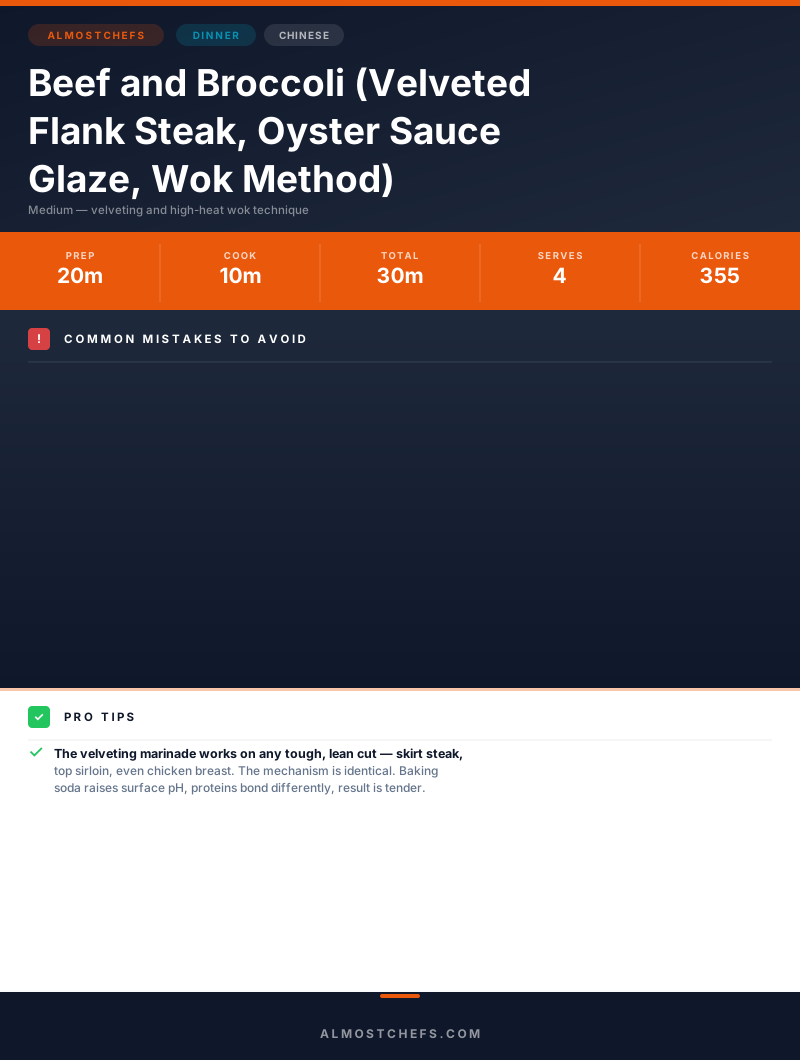
The Science of
Beef and Broccoli (Velveted Flank Steak, Oyster Sauce Glaze, Wok Method)
We turned everything on this page into a beautiful, flour-proof PDF cheat sheet. Print it out, stick it to your fridge, and never mess up your beef and broccoli (velveted flank steak, oyster sauce glaze, wok method) again.
*We'll email you the high-res PDF instantly. No spam, just perfectly cooked meals.
AlmostChefs Editorial Team
We translate the internet's most popular cooking videos into foolproof, beginner-friendly written recipes. We analyze multiple methods, test them in our kitchen, and engineer a single "Master Recipe" that gives you the best possible result with the least possible stress.