The Ultimate Banh Mi (Stop Settling for Soggy Baguettes)
A crispy Vietnamese baguette layered with creamy pâté, quick-pickled daikon and carrot, grilled pork, fresh herbs, and a sriracha drizzle. We broke down the technique behind the world's most underrated street food to show you exactly why the assembly order is everything.
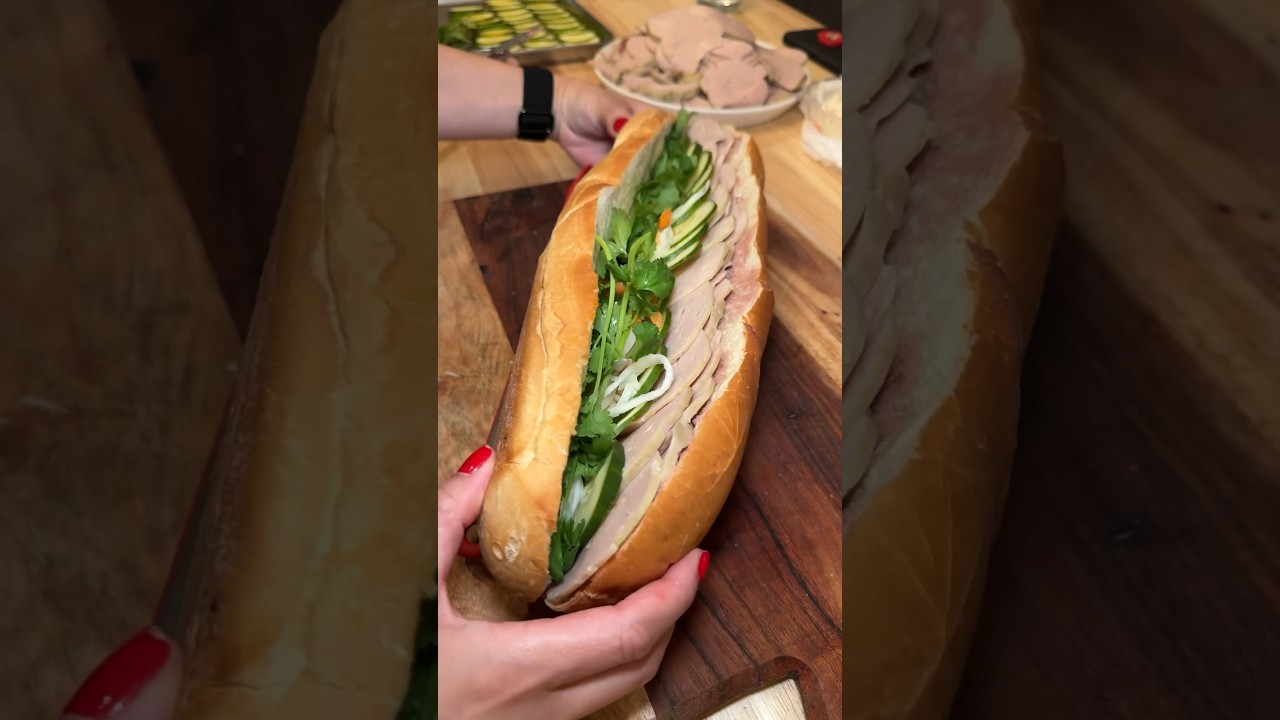
“Most homemade banh mi fails at the same point: the bread goes soft within three minutes of assembly and the whole thing collapses into a wet mess. This is not a bread problem. It is a sequencing problem. The order in which you apply each layer is a moisture management system. Get it right and the baguette stays crisp through the last bite. Get it wrong and you're eating a salad with a bread problem.”
Why This Recipe Works
Banh mi is one of the most structurally sophisticated sandwiches in the world, which is remarkable given that it was designed to be eaten standing on a sidewalk in under four minutes. The French brought the baguette to Vietnam during colonization. The Vietnamese looked at it and thought: this is a vessel. Then they filled it with everything that French cuisine would never put inside bread — fish sauce, pickled root vegetables, fresh herbs, liver pâté — and created something that neither culture could have produced alone.
The result is a sandwich built on deliberate contradiction. Hot and cold. Rich and acidic. Creamy and crunchy. Herbaceous and savory. Every element exists in opposition to the element beside it, and the whole thing holds together because of a baguette that is simultaneously the lightest and crispiest bread in the world.
Most homemade versions collapse at exactly one point: the bread. The Vietnamese baguette is not a French baguette with a different label. It is a different object. Its crumb is airy and porous — almost hollow — and its crust is thin, crackly, and aggressively crisp. This makes it the perfect vessel until you put wet things inside it, at which point it becomes a liability. The entire technique of assembling a banh mi is really a moisture management problem disguised as a recipe.
The Moisture Architecture
There are three fat barriers between the baguette and its fillings: butter, pâté, and mayonnaise. Each one serves a distinct function, and none of them are optional.
The butter goes on first, directly on the hot toasted crumb. At this temperature, it absorbs slightly into the surface and begins to seal the pores of the bread. The pâté on the bottom half creates a dense lipid layer that insulates the crumb from the warm, juice-releasing pork above it. The mayonnaise on the top half seals the lid against the cool, wet vegetables below. Remove any one of these layers and you create a direct pathway for moisture to reach the bread. The sandwich becomes lunch soup within minutes.
The toasting step is the foundation. Two to three minutes cut-side down in a dry cast iron skillet does something the oven cannot: it creates direct conductive heat contact between the crumb and the surface, producing a lightly caramelized, structurally sealed interior. The Maillard reaction at the crumb surface closes the pores that would otherwise act as a sponge. Without this step, every subsequent moisture barrier you build is working against the law of physics.
The Pickle Logic
Quick-pickling is not marinating. Marinating is about flavor penetration. Quick-pickling is about structural transformation — you are using acid and osmosis to pull moisture out of the vegetable cells and replace it with vinegar solution, changing the texture from raw-crunchy to crisp-tender while simultaneously building acidity that will cut through the fat of the pâté and pork.
The daikon and carrot need a minimum of one hour. In thirty minutes, the surface is pickled but the interior is still raw and sharp. At one hour, you've reached the minimum viable texture. At two hours, the crunch is cleaner and the flavor is rounder. At eight hours, you have a pickle worth eating on its own. Make the largest batch that fits in your jar and use the leftovers on everything for the next two weeks — grain bowls, tacos, rice dishes. The brine is also reusable.
The Protein Priority
The pork needs two things: thin slices and high heat. Thin slices ensure the meat cooks through before the exterior burns. High heat from a properly preheated heavy skillet creates the caramelized, slightly charred edges that give the filling its savory intensity. A crowded pan drops the surface temperature and the meat steams in its own liquid — you get gray, textureless pork instead of something with actual character.
Fish sauce in the marinade is not negotiable. It is the bridge between the French pâté and the Vietnamese vegetables. It adds the fermented umami depth that makes every other flavor in the sandwich land harder. If you've ever eaten banh mi and wondered why yours doesn't taste quite right, fish sauce is what you left out.
The diagonal cut at the end is structural, not stylistic. It shortens the sandwich's cross-section so the baguette holds its shape under compression when you bite. A straight cut leaves a longer, more flexible structure that lets the fillings slide forward. Cut diagonally, eat immediately, eat fast — that is the banh mi contract.
Where Beginners Mess This Up
Before we start, read this. These are the 4 reasons your the ultimate banh mi (stop settling for soggy baguettes) will fail:
- 1
Skipping the pickle lead time: The pickled daikon and carrot need at least 1 to 2 hours to develop. Freshly mixed vegetables are still sharp and acrid — the vinegar hasn't had time to mellow the raw bite or crisp-tender the texture. If you make the pickle right before assembly, the banh mi tastes unbalanced and green. Plan ahead or make the pickle the night before.
- 2
Not toasting the baguette cut-side down: The interior crumb of a baguette is porous and absorbent. Without direct-contact toasting, it turns to paste the second it touches the pâté and mayo. Two to three minutes cut-side down in a dry skillet creates a sealed, slightly caramelized surface that resists moisture for the duration of the sandwich.
- 3
Applying the wrong spreads to the wrong halves: Pâté goes on the bottom half. Mayonnaise goes on the top. This is not aesthetic preference — it is structural. The pâté creates a dense fat barrier under the warm pork, which is the main moisture threat. The mayo on top seals the lid against the vegetables. Reversing them changes the failure point.
- 4
Overcrowding the pork in the pan: Thinly sliced pork needs space to char at the edges. A crowded pan drops the temperature and the meat steams instead of sears. You lose the caramelized edges that give the filling its savory backbone. Cook in batches if your pan is small.
The Video Reference Library
Want to see it in action? Here are the exact videos we analyzed and combined to build this foolproof recipe translation:
The source video for this recipe. Clear breakdown of the pickle-first workflow and why the assembly sequence prevents sogginess. Essential watch before your first build.
🛠️ Core Equipment
- Heavy stainless or cast iron skilletNeeded for two jobs: toasting the baguette cut-side down and searing the pork. A [heavy skillet](/kitchen-gear/review/cast-iron-skillet) holds temperature when cold bread hits the surface, which a thin non-stick pan cannot do. Without retained heat, the toast is pale and the pork steams.
- Serrated bread knifeA straight-edge knife compresses the baguette instead of cutting it. You need a serrated blade to split the loaf cleanly and to slice the finished sandwich diagonally without crushing the fillings down into the bread.
- Glass jar or airtight container for the pickleThe pickling brine is acidic and will react with reactive metals. Glass or BPA-free plastic keeps the daikon and carrot crisp without metallic off-flavors. Also lets you make a large batch and store extras for the week.
- Small spatula or offset knifeEven pâté and mayo layers matter. Thick spots create flavor imbalance and compromise the moisture barrier at thin spots. An offset spatula gives you the control to spread consistently thin.
The Ultimate Banh Mi (Stop Settling for Soggy Baguettes)
🛒 Ingredients
- ✦1 Vietnamese or French baguette, 12 inches long
- ✦1 tablespoon unsalted butter, softened
- ✦3 tablespoons chicken liver pâté or quality pork pâté
- ✦3 tablespoons mayonnaise
- ✦6 ounces pork shoulder or chicken breast, thinly sliced
- ✦2 teaspoons fish sauce
- ✦1 teaspoon sugar
- ✦1 cup pickled daikon and carrot strips (prepared 1-2 hours ahead)
- ✦1 cup julienned daikon radish (for pickling)
- ✦1 cup julienned carrot (for pickling)
- ✦½ cup rice vinegar
- ✦3 tablespoons sugar (for pickling brine)
- ✦1 teaspoon salt (for pickling brine)
- ✦½ cucumber, thinly sliced lengthwise into ribbons
- ✦¼ cup fresh cilantro leaves, loosely packed
- ✦3 fresh jalapeño slices, seeds removed for less heat
- ✦2 teaspoons sriracha or Vietnamese chili sauce
- ✦½ teaspoon kosher salt
- ✦¼ teaspoon ground black pepper
- ✦2 tablespoons neutral oil for cooking protein
👨🍳 Instructions
01Step 1
Combine the julienned daikon and carrot with rice vinegar, 3 tablespoons sugar, and 1 teaspoon salt in a glass container. Stir well, cover, and leave at room temperature for at least 1 to 2 hours, stirring occasionally, until crisp-tender and tangy.
02Step 2
Combine the thinly sliced pork with fish sauce, ½ teaspoon sugar, and a pinch of black pepper in a small bowl. Marinate for 15 minutes while you prepare the baguette.
03Step 3
Split the baguette lengthwise with a serrated knife, creating two even halves with open faces.
04Step 4
Toast both halves cut-side down in a dry skillet over medium-high heat for 2 to 3 minutes until the interior is lightly golden and the crust crackles when pressed.
05Step 5
Spread the softened butter evenly across the inner surface of both toasted halves immediately while still warm.
06Step 6
Spread the pâté in a thin, even layer (about ⅛-inch thick) across the bottom half of the baguette.
07Step 7
Spread the mayonnaise across the top half in an equally thin, even layer.
08Step 8
Heat the neutral oil in the skillet over medium-high heat until shimmering. Add the marinated pork in a single layer — do not crowd the pan. Cook for 3 to 4 minutes, turning once, until cooked through with lightly charred edges.
09Step 9
Lay the warm pork strips in a slightly overlapping layer across the pâté-covered bottom half.
10Step 10
Arrange the cucumber ribbons in a single layer over the pork.
11Step 11
Drain the pickled daikon and carrot thoroughly and distribute evenly over the cucumber. Discard or reserve the excess brine.
12Step 12
Scatter the cilantro leaves generously across the vegetables.
13Step 13
Place the jalapeño slices in a line along the length of the sandwich so each bite contains heat.
14Step 14
Drizzle the sriracha in a thin zigzag across the jalapeños.
15Step 15
Press the top half firmly onto the filled bottom half. Slice diagonally with a serrated knife using a gentle sawing motion. Serve immediately.
Nutrition Per Serving
Estimates based on standard preparation. Adjustments alter macros.
🔄 Substitutions
Instead of Pork shoulder...
Use Grilled tofu or tempeh
Marinate tofu in miso, soy sauce, and a few drops of sesame oil for 30 minutes before grilling. Firmer texture and deepened umami. Slice thin and sear hard for caramelized edges.
Instead of Pâté (chicken liver or pork)...
Use Hummus or white bean spread
Lighter and earthier. Loses the richness and the distinctly French-Vietnamese character of the original, but functions identically as a moisture barrier and creamy base.
Instead of Mayonnaise...
Use Greek yogurt mixed with 1 teaspoon Dijon mustard
Tangy and slightly lighter. Reduces calories by roughly 50 per serving and adds probiotics. Works well if the yogurt is thick — thin Greek yogurt will make the top half soggy.
Instead of Fish sauce...
Use Soy sauce or tamari with 1 teaspoon rice vinegar
Less funk, slightly more acidity. Maintains the savory backbone. Use tamari for a gluten-free option. Don't skip the vinegar — it approximates the fermented sharpness of fish sauce.
🧊 Storage & Reheating
In the Fridge
Banh mi does not store assembled. Once built, eat it within 20 minutes or the baguette softens past recovery. Store components separately: pickled vegetables keep for 2 weeks refrigerated, cooked pork keeps for 3 days.
In the Freezer
The pork filling can be frozen in portions for up to 1 month. Thaw overnight in the fridge and reheat in a hot skillet. Do not freeze the assembled sandwich.
Reheating Rules
Reheat pork in a dry skillet over medium-high heat for 2 minutes until the edges re-caramelize. Toast a fresh baguette and assemble to order.
❓ Frequently Asked Questions
Why does my banh mi get soggy so fast?
The moisture barrier failed somewhere. Either the baguette wasn't toasted long enough, the pâté or mayo layer was too thin or uneven, or the pickled vegetables weren't drained thoroughly before layering. All three spreads (butter, pâté, mayo) exist specifically to waterproof the crumb against the wet ingredients above and below them.
Can I use rotisserie chicken instead of grilling pork?
Yes. Shred the rotisserie chicken and toss it in fish sauce, a pinch of sugar, and black pepper. You won't get the charred edges, but the flavor is solid. Warm it briefly in a skillet before layering.
Where do I find Vietnamese baguettes?
Asian grocery stores, Vietnamese bakeries, and some specialty markets. They're smaller and lighter than French baguettes — a 12-inch Vietnamese baguette weighs about half what a standard French baguette does. If you can't find them, use the thinnest French baguette available and reduce toasting time by 30 seconds.
How far ahead can I make the pickled vegetables?
Up to two weeks refrigerated in an airtight glass container. The flavor peaks around day 3. After two weeks the vegetables begin to soften past crisp-tender into mushy — still edible but not ideal for banh mi.
Is pâté necessary or can I skip it?
You can skip it, but you're removing one of the three things that makes banh mi distinct from every other sandwich. The pâté provides richness, umami depth, and a moisture barrier that mayonnaise alone can't replicate. If you can't find or won't eat pâté, a thick layer of white bean spread is the best structural substitute.
What protein works best besides pork?
Char siu (Chinese BBQ pork) is the closest swap and arguably even better. Grilled lemongrass chicken is the most common restaurant alternative. Shrimp works if cooked hard and fast in a very hot pan. The key in all cases is high heat and caramelized edges — the char is what makes the protein interesting against the cool, acidic vegetables.
The Science of
The Ultimate Banh Mi (Stop Settling for Soggy Baguettes)
We turned everything on this page into a beautiful, flour-proof PDF cheat sheet. Print it out, stick it to your fridge, and never mess up your the ultimate banh mi (stop settling for soggy baguettes) again.
*We'll email you the high-res PDF instantly. No spam, just perfectly cooked meals.
AlmostChefs Editorial Team
We translate the internet's most popular cooking videos into foolproof, beginner-friendly written recipes. We analyze multiple methods, test them in our kitchen, and engineer a single "Master Recipe" that gives you the best possible result with the least possible stress.