Classic Bangers and Mash (The Pub Secret Nobody Talks About)
Juicy pork sausages, creamy root vegetable mash, and a deeply savory caramelized onion gravy — the British pub classic rebuilt from the ground up. We broke down what actually makes the gravy rich and the mash silky, so you stop getting watery results at home.

“Bangers and mash looks simple on paper. It's sausages and potatoes — what could go wrong? Quite a lot, as it turns out. Pale sausages with no crust, gluey mash that sticks to the spoon, and thin gravy with the depth of tap water. Every one of these failures has a specific cause and a specific fix. The dish is forgiving; the technique is not.”
Why This Recipe Works
Bangers and mash is not complicated. That's precisely what makes it easy to get wrong. When a dish has three components — sausages, mash, gravy — each one has to carry its weight. There's nothing else to hide behind.
The Sausage Problem
Most home cooks either undercolor their sausages or split the casing trying to speed things up. The fix is straightforward: medium-high heat, one tablespoon of oil, and patience. You want a deep golden crust — not grey, not pale — on every side before the sausage ever touches the gravy. That crust is Maillard reaction compounds. It is flavor. It is also the foundation of the entire sauce.
When you remove the sausages, what's left in the pan is a layer of browned fat and caramelized proteins known as fond. This is not a mess to clean up — it's the most concentrated flavor in the entire dish, and everything that follows exists to capture it.
Building a Gravy That Tastes Like It Took All Day
The onions go into the same fat the sausages left behind. This is non-negotiable. That fat carries flavor compounds that dissolve into the onions as they soften, building a base layer of savory depth you simply cannot replicate by starting with fresh oil and fresh onions in a clean pan.
Then comes patience. Twenty minutes, medium heat, frequent stirring. The onions should end up mahogany brown — not translucent, not golden, but the deep reddish-brown of properly reduced natural sugars. At this point they will smell almost sweet. That's correct.
Tomato paste goes in next, stirred for a full minute over direct heat. Raw tomato paste is aggressive and one-dimensional. One minute of sautéing transforms it, developing a rounder, deeper flavor that reads as umami rather than acidity. Then the broth and balsamic go in, and you scrape up every brown bit from the pan bottom with a wooden spoon. Those bits dissolve instantly into the liquid and the gravy goes from thin and pale to mahogany in seconds.
The Mash Architecture
The sweet potato addition is not a health compromise — it's a flavor decision. One-third sweet potato to two-thirds russet produces a mash that is slightly earthier and naturally sweeter than pure russet, which means it needs less butter to taste rich and it stands up to a bold onion gravy rather than disappearing underneath it.
The single most important technique in making good mash is temperature. Warm your butter and milk together before they touch the potato — cold dairy shocks the starch and produces a gluey, sticky texture that no amount of seasoning can fix. The fat needs to coat the starch granules first. This is food science, not preference.
Use a potato masher or a ricer. Stop before it looks completely smooth. A few small lumps signal that you haven't overworked the starch. Perfectly uniform mash from a food processor is actually the worst-case outcome — elastic, sticky, and textureless.
The Dijon mustard folded in at the end is a pub trick that most printed recipes leave out. It doesn't make the mash taste like mustard. It sharpens all the other flavors — the sweet potato, the butter, the salt — by providing a background acidity that the dairy alone can't deliver.
Why It All Works Together
The bitterness of the caramelized onion gravy, the acidity of the balsamic, the sweetness of the sweet potato, and the sharpness of the mustard mash are not accidental. Each element is calibrated against the others. The dish works because it is balanced — fat against acid, sweet against savory, rich gravy against fluffy mash. Get each component right and the plate is better than the sum of its parts. That's what makes it a pub classic and not just a budget meal.
Where Beginners Mess This Up
Before we start, read this. These are the 4 reasons your classic bangers and mash (the pub secret nobody talks about) will fail:
- 1
Not browning the sausages properly: The sausage skin needs to develop a deep golden crust in a hot, oiled pan before you do anything else. Pale steamed sausages have no Maillard reaction products — which means no flavor on the outside, and no fond on the pan bottom to build the gravy from. The brown bits left in the skillet after searing are not burnt debris; they are the entire foundation of your gravy.
- 2
Rushing the onion caramelization: Real caramelized onions take 20-25 minutes over medium heat. Anything less and you have softened onions with residual sharpness — not the sweet, mahogany-colored, flavor-dense base that makes pub gravy taste like it simmered all day. Turn up the heat and you get browned edges on raw centers. Medium heat. Twenty minutes. No shortcuts.
- 3
Over-working the mash: Potatoes release starch when agitated. Over-mashing or using a food processor activates that starch into a paste. Mash until just smooth — small, occasional chunks are a feature, not a flaw. Use a hand masher or a ricer, not a blender.
- 4
Adding cold milk to the mash: Cold dairy shocks the potato starch and produces a gluey, slightly grey mash. Warm the butter and milk together before adding — the fat coats the starch granules before water can activate them, producing a silky, cohesive texture.
The Video Reference Library
Want to see it in action? Here are the exact videos we analyzed and combined to build this foolproof recipe translation:
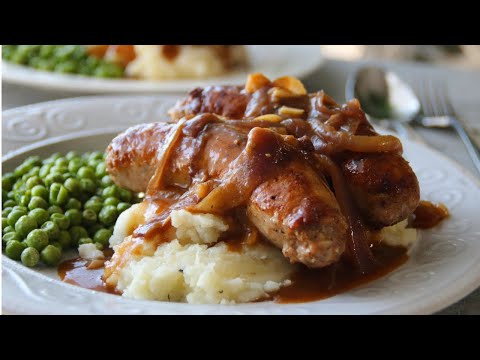
The reference video that breaks down the onion gravy technique in full, including the exact color to target for caramelized onions and the deglazing method that pulls every bit of fond off the pan.
2. How to Make Perfect Mashed Potatoes
Comprehensive walkthrough of the fat-first mashing technique and why warming dairy before adding it prevents gluey, starchy results.
3. One-Pan British Sausage DinnerDemonstrates the full one-pan workflow — sausages first, fond preserved, onions built in the same fat — showing how each step feeds into the next.
🛠️ Core Equipment
- Large heavy-bottomed skillet ↗You need sufficient surface area to brown sausages without crowding and to caramelize a full two onions without steaming them. A [cast iron skillet](/kitchen-gear/review/cast-iron-skillet) is ideal — it holds heat evenly and builds exceptional fond.
- Large pot ↗For boiling both potato varieties simultaneously. The russet and sweet potato cubes need room to cook without crowding or they stew rather than boil and turn waterlogged.
- Potato masher or ricer ↗A [potato ricer](/kitchen-gear/review/potato-ricer) produces the most consistent, lump-free mash without overworking the starch. A hand masher is a perfectly acceptable second choice. A food processor is not a choice.
- Wooden spoon or silicone spatula ↗For deglazing — scraping up the fond after you add the broth. Every browned bit is concentrated flavor. A flat-edged wooden spoon gets into the corners of the pan.
Classic Bangers and Mash (The Pub Secret Nobody Talks About)
🛒 Ingredients
- ✦8 lean pork sausages (about 2 pounds total)
- ✦1 pound russet potatoes, peeled and cubed
- ✦12 ounces sweet potatoes, peeled and cubed
- ✦2 medium yellow onions, thinly sliced
- ✦2 tablespoons olive oil, divided
- ✦3 cloves garlic, minced
- ✦1 cup low-sodium beef or vegetable broth
- ✦1 tablespoon tomato paste
- ✦1 tablespoon balsamic vinegar
- ✦1 teaspoon fresh thyme leaves
- ✦2 tablespoons unsalted butter
- ✦1/4 cup whole milk, warmed
- ✦1 teaspoon Dijon mustard
- ✦Sea salt and cracked black pepper to taste
- ✦1/2 teaspoon garlic powder
- ✦Fresh green onions, chopped, for garnish
👨🍳 Instructions
01Step 1
Bring a large pot of generously salted water to a boil over high heat. Add the cubed russet and sweet potatoes together.
02Step 2
Cook the potatoes until completely fork-tender, about 15-18 minutes. Drain thoroughly and let them sit in the colander for 2 minutes to steam dry.
03Step 3
While the potatoes cook, heat 1 tablespoon of olive oil in a large skillet over medium-high heat. Add the sausages and brown on all sides until a deep golden crust forms, about 10-12 minutes total. Transfer to a plate.
04Step 4
Add the remaining tablespoon of olive oil to the same skillet. Add the sliced onions and a pinch of salt. Reduce heat to medium.
05Step 5
Sauté the onions, stirring frequently, until deeply caramelized and mahogany brown — 20-25 minutes. Do not rush this step.
06Step 6
Stir in the minced garlic and cook for 1 minute until fragrant.
07Step 7
Add the tomato paste and stir constantly for 1 minute to deepen the flavor and cook out the raw paste taste.
08Step 8
Pour in the broth and balsamic vinegar, scraping up all the browned bits from the pan bottom. Add the fresh thyme leaves.
09Step 9
Return the sausages to the skillet and simmer in the gravy over low heat for 5 minutes to heat through and let the flavors meld.
10Step 10
In a small saucepan, warm the butter and milk together over low heat until the butter melts. Do not boil.
11Step 11
Mash the drained potatoes with the warm butter-milk mixture, Dijon mustard, garlic powder, salt, and pepper until smooth with just a few small chunks remaining.
12Step 12
Taste and adjust seasoning on both the mash and the gravy.
13Step 13
Spoon the mash onto plates, nestle the sausages alongside, and ladle the caramelized onion gravy over everything. Garnish with chopped green onions. Serve immediately.
Nutrition Per Serving
Estimates based on standard preparation. Adjustments alter macros.
🔄 Substitutions
Instead of Pork sausages...
Use Turkey or chicken sausages
40% less fat and significantly less saturated fat. Slightly less rich flavor but still absorbs the onion gravy well. Look for varieties with visible herbs — the leaner meat needs seasoning help.
Instead of All russet potatoes...
Use 50/50 russet and sweet potato blend
Already incorporated in this recipe. Increases fiber by roughly 15% and produces a slightly sweeter, earthier mash with a better blood sugar response than pure russet.
Instead of Whole milk...
Use Unsweetened oat milk or Greek yogurt
Oat milk produces a lighter mash with a neutral flavor. Greek yogurt adds a faint tang that pairs well with the Dijon. Both save 30 calories per serving.
Instead of Beef broth...
Use Low-sodium mushroom or vegetable broth
Reduces sodium by 60% and adds deep umami from mushroom varieties. The flavor difference is minimal when the onions are properly caramelized.
🧊 Storage & Reheating
In the Fridge
Store mash and sausages separately in airtight containers for up to 3 days. The gravy keeps well on its own and actually improves overnight as the onion flavors deepen.
In the Freezer
The mash does not freeze well — the texture breaks down on thaw. The sausages and gravy freeze fine for up to 2 months. Make fresh mash when reheating.
Reheating Rules
Reheat the gravy and sausages together in a covered pan over low heat with a splash of broth. For the mash, reheat in a pot over low heat with a tablespoon of warm milk stirred in to loosen it.
❓ Frequently Asked Questions
Why are my sausages splitting open in the pan?
The pan was too hot or you pierced the skins. Keep the heat at medium-high, not high, and never pierce a sausage before or during cooking. The casing is under pressure — puncture it and the juices escape immediately.
My gravy is too thin. How do I fix it?
Remove the sausages and reduce the gravy uncovered over medium-high heat for 3-5 minutes, stirring occasionally. Reduction concentrates flavor and thickens through evaporation. Avoid adding flour or cornstarch unless you want an opaque, starchy consistency.
Can I make this ahead of time?
The gravy and sausages reheat well. The mash does not — it tightens and loses its texture. If you want to prep ahead, make the gravy and brown the sausages in advance, then make fresh mash just before serving.
What's the best sausage for bangers and mash?
Traditional British bangers have a finer grind and higher herb content than most American pork sausages — look for Cumberland or Lincolnshire varieties at specialty butchers. In a pinch, any good-quality fresh pork sausage with visible seasoning will work.
Why add balsamic vinegar to the gravy?
It adds acidity and a faint sweetness that sharpens the caramelized onion flavor and cuts through the fat from the sausages. It doesn't make the gravy taste like balsamic — used in small amounts it acts as a flavor amplifier, not a primary flavor.
Can I use instant mashed potatoes?
You can, but you shouldn't. Instant mash has no textural character and the flavor is distinctly processed. The mash in this dish is not a neutral carrier — it's half the meal. The ten extra minutes for real potatoes are not optional if you care about the result.

The Science of
Classic Bangers and Mash (The Pub Secret Nobody Talks About)
We turned everything on this page into a beautiful, flour-proof PDF cheat sheet. Print it out, stick it to your fridge, and never mess up your classic bangers and mash (the pub secret nobody talks about) again.
*We'll email you the high-res PDF instantly. No spam, just perfectly cooked meals.
AlmostChefs Editorial Team
We translate the internet's most popular cooking videos into foolproof, beginner-friendly written recipes. We analyze multiple methods, test them in our kitchen, and engineer a single "Master Recipe" that gives you the best possible result with the least possible stress.