Best Cutting Boards for Home Cooks (2026)
A great cutting board makes every kitchen task easier and protects your knives. After reviewing aggregated testing from Serious Eats (who ran chef knives 200 times over 19 boards), America's Test Kitchen (who tested hundreds of boards over the years), and Wirecutter, we identified four standout cutting boards that cover every budget and cooking style. The short version: go wood for your main board, keep a plastic board for raw meat and dishwasher days.
Serious Eats top pick across multiple rounds of testing, and the dream board of most professional test cooks. The Boardsmith end-grain maple surface protects knives better than anything else tested, and the build quality is heirloom-grade. If you want one cutting board that lasts a lifetime and respects your knives, this is it.
Quick Comparison
| Product | Price | Rating | Verdict | Link |
|---|---|---|---|---|
BESTThe Boardsmith Maple End-Grain Cutting Board The Boardsmith | $175.00 | 4.9 | Serious Eats top pick across multiple rounds of testing, and the dream board of most professional test cooks. The Boardsmith end-grain maple surface protects knives better than anything else tested, and the build quality is heirloom-grade. If you want one cutting board that lasts a lifetime and respects your knives, this is it. | Check Price |
#2OXO Good Grips 2-Piece Cutting Board Set OXO | $39.99 | 4.7 | Serious Eats top plastic pick and a perennial ATK and Wirecutter favorite. The OXO 2-piece set is the practical workhorse every kitchen needs — use the plastic board for raw chicken and fish, then toss it in the dishwasher. The grip on these boards is exceptional, and ATK long-term testing showed negligible knife dulling compared to hardwood boards. | Check Price |
Material The (grippy) ReBoard Material Kitchen | $65.00 | 4.6 | Serious Eats #1 plastic pick for 2026. The ReBoard stands out for its exceptional grip, eco-conscious materials, and thoughtful reversible design. A great choice for eco-minded cooks who want a practical everyday plastic board. | Check Price |
TeakHaus Edge-Grain Teak Cutting Board TeakHaus | $85.00 | 4.5 | A popular and beautiful mid-range choice, but approach with informed expectations: ATK warns that teak natural silica content dulls blades faster than hardwoods like maple. If looks matter and you sharpen your knives regularly, this is a solid option. If knife longevity is the priority, spend more on a maple end-grain board. | Check Price |
Best Cutting Boards Tested: Wood vs Plastic vs Composite
How to Choose the Best Cutting Board for Your Kitchen
Buying Guide Infographic
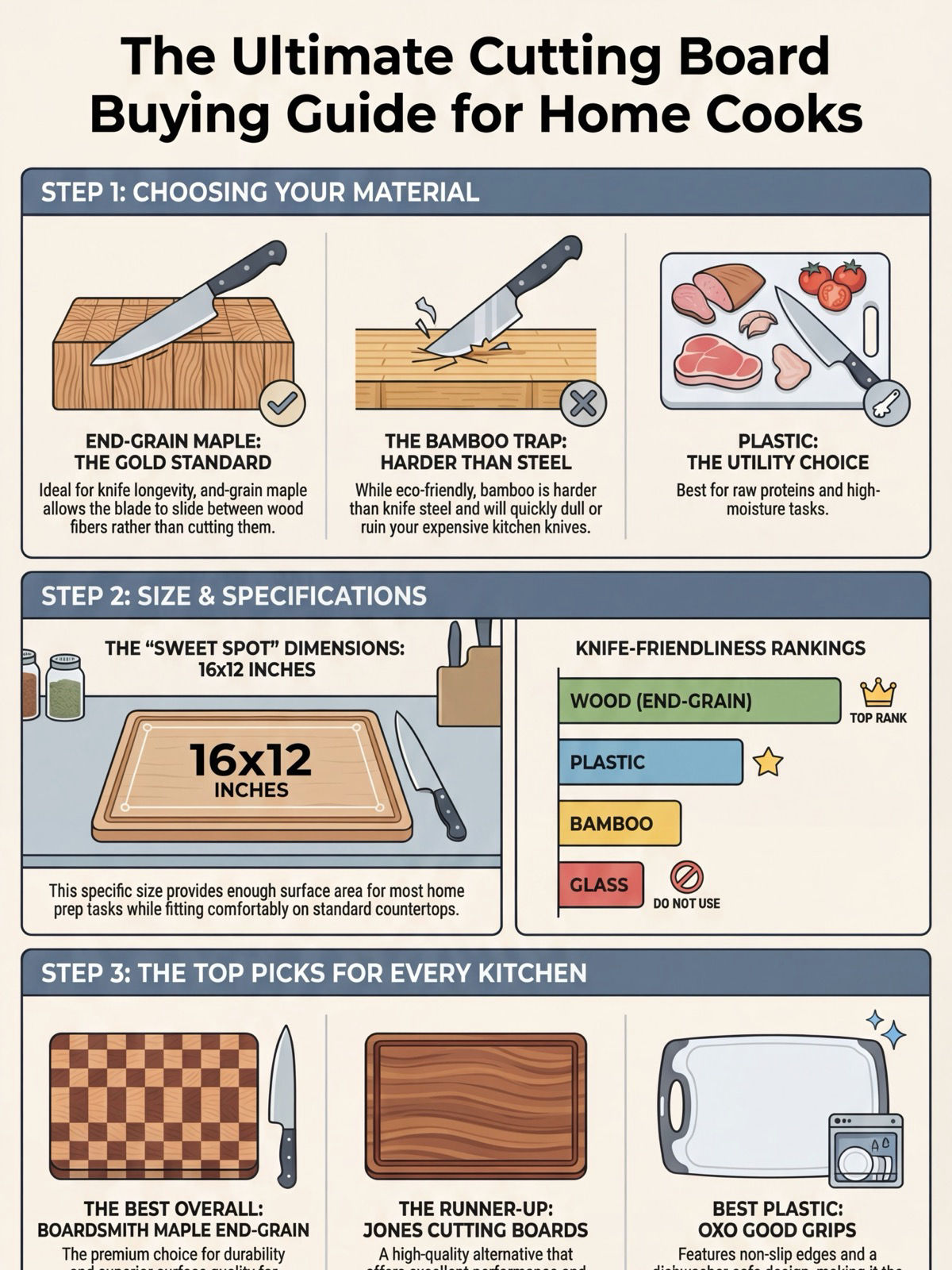
Tap to view full size
Detailed Reviews
The Boardsmith Maple End-Grain Cutting Board
Serious Eats top pick across multiple rounds of testing, and the dream board of most professional test cooks. The Boardsmith end-grain maple surface protects knives better than anything else tested, and the build quality is heirloom-grade. If you want one cutting board that lasts a lifetime and respects your knives, this is it.
Pros
- End-grain maple is the gold standard for knife protection — blades cut between fibers rather than across them
- Smooth, marble-like surface that becomes finer with use and oiling
- Exceptional craftsmanship with tight, even seams and no rough spots
- Available in multiple sizes and customizable with juice grooves and rubber feet
- Will last decades with minimal care
Cons
- Expensive — the 16x22 inch board costs $175 or more
- Heavy (close to 20 pounds at full size) and too large for most home sinks
- Requires regular oiling and hand-washing only
OXO Good Grips 2-Piece Cutting Board Set
Serious Eats top plastic pick and a perennial ATK and Wirecutter favorite. The OXO 2-piece set is the practical workhorse every kitchen needs — use the plastic board for raw chicken and fish, then toss it in the dishwasher. The grip on these boards is exceptional, and ATK long-term testing showed negligible knife dulling compared to hardwood boards.
Pros
- Excellent non-slip grip — stays firmly on the counter without a damp towel underneath
- Two sizes in one set cover small jobs (citrus, garlic) and medium prep work
- Plastic is gentler on knives than glass, bamboo, or stone
- Dishwasher safe for easy cleaning after raw meat handling
- Affordable entry point with proven long-term reliability
Cons
- Plastic accumulates knife scarring over time, which can harbor bacteria if not sanitized properly
- Not as gentle on knife edges as an end-grain wood board
- Lacks the aesthetic appeal of a wooden board
Material The (grippy) ReBoard
Serious Eats #1 plastic pick for 2026. The ReBoard stands out for its exceptional grip, eco-conscious materials, and thoughtful reversible design. A great choice for eco-minded cooks who want a practical everyday plastic board.
Pros
- Made from 65% recycled plastic — more sustainable than standard plastic boards
- Built-in textured edges grip the counter without needing a damp towel
- Reversible — one side for produce, one for proteins
- Lightweight and easy to maneuver despite good size
- Knife-friendly surface comparable to other quality plastic boards
Cons
- More expensive than standard plastic boards at $65
- Surface can show knife marks over time like any plastic board
TeakHaus Edge-Grain Teak Cutting Board
A popular and beautiful mid-range choice, but approach with informed expectations: ATK warns that teak natural silica content dulls blades faster than hardwoods like maple. If looks matter and you sharpen your knives regularly, this is a solid option. If knife longevity is the priority, spend more on a maple end-grain board.
Pros
- Beautiful, warm appearance — doubles as a serving board
- More affordable than end-grain maple boards
- Solid, heavy board that stays put during prep
- Built-in juice groove on one side
Cons
- Teak contains natural silica that can dull knives faster than maple or walnut
- Edge-grain construction is less knife-friendly than end-grain
- Requires oiling like any wood board; not dishwasher safe
Our Methodology
Our recommendations are based on aggregated testing from Serious Eats, America's Test Kitchen, and Wirecutter. Evaluation criteria included knife blade protection (both subjective feel and measured dulling), surface stability, ease of cleaning, durability over time, weight and maneuverability, and long-term material performance. We also considered real-world maintenance requirements and value at each price point.
Frequently Asked Questions
Is wood or plastic better for a cutting board?
Both have a place in your kitchen. Wood (especially end-grain hardwood like maple) is gentler on knife edges and looks beautiful, but requires hand-washing and regular oiling. Plastic is dishwasher-safe and great for raw meat, though it dulls knives slightly faster and can harbor bacteria in deep knife grooves if not properly cleaned. ATK found very little difference in actual knife dulling between their favorite wood and plastic boards.
What is end-grain vs. edge-grain cutting board?
End-grain boards show the cross-section of wood. Knives cut between the wood fibers rather than across them, making end-grain the most knife-friendly option. Edge-grain boards are more common and less expensive — still good, just not quite as gentle on blades. Both are far better than glass, marble, or bamboo.
Are glass or marble cutting boards bad for knives?
Yes — avoid them entirely for cutting. Glass and marble are harder than your knife steel, which rapidly rolls and dulls the blade edge. ATK says this emphatically: never cut on glass or marble.
How do you clean and maintain a wood cutting board?
Hand-wash with warm soapy water, then dry immediately and stand it on its edge to air out. Every month or so, rub it with food-grade mineral oil or board butter. Never put a wood board in the dishwasher or soak it in water.
What size cutting board should I get?
ATK recommends at least 15 x 20 inches for your primary board. The sweet spot for most cooks is around 16 x 12 inches: spacious enough for real cooking but small enough to fit in the sink.
Affiliate Disclosure: AlmostChefs earns a commission on qualifying purchases through Amazon Associates links at no extra cost to you. We independently evaluate and recommend products that meet our high standards for quality and performance.